
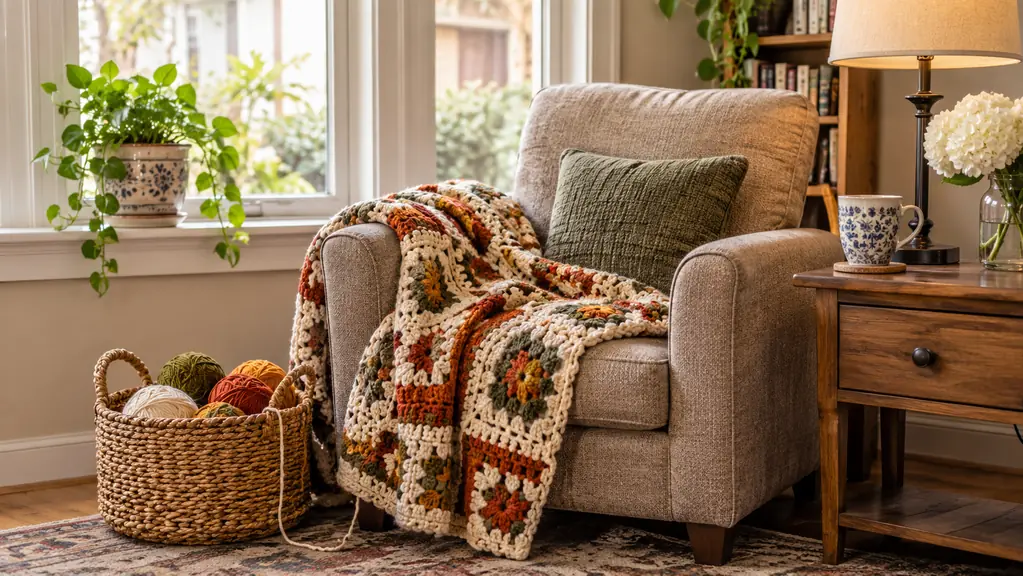
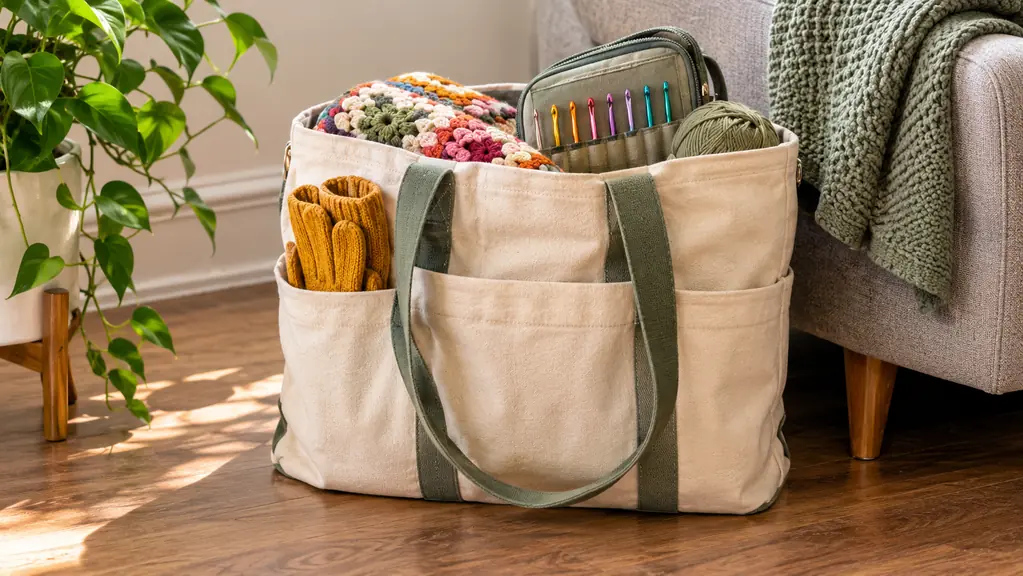
I own both pairs, so the short answer comes first. For crochet, I reach for the Dritz Crafters Comfort Gloves. They live in the outside pocket of my project bag and have since February, when I bought them. The fingerless compression gloves I bought at a drugstore before that are in a kitchen drawer and have been there since about a month after I brought them home, because they pinched across my palm in a way I could not get used to. That is the comparison in two sentences. The rest of this page is what I wish somebody had told me at the yarn shop table, because these two gloves are not really after the same job, and knowing which job you have saves you from buying the wrong one twice.
I have crocheted for about 35 years, taught myself from a library book at 29 by propping it open in front of a mirror, and I am left-handed. I am 64 now, retired from a job in the school office, and 5 foot 1, which means most tools and most chairs were designed for somebody else's hands and somebody else's legs. I work in a small armchair by the front window, floor lamp at my left shoulder, wooden yarn bowl on the side table to my right. After about an hour of work the base of my left thumb lets me know it has been an hour. That hour is exactly what both of these gloves are aimed at, and they behave very differently across it.
| Dritz Crafters Comfort Gloves | Fingerless Compression Gloves | |
|---|---|---|
| Fingertips | Cut back far enough that I can feel the hook shaft and the yarn | Open on the pair I tried, but cut shorter, so the yarn dragged on the edge |
| Compression | Mild and even across the back of the hand | Firm pressure, and it stays firm all evening |
| Sizes offered | Medium only, sold as a pair | The drugstore pair came in small, medium and large |
| Palm comfort | No pinch at the base of my thumb | Pinched across my palm from the first evening |
| Fabric | Cotton, lightweight, listed as medium stretch | Synthetic knit with more stretch and more snap back |
| Care | Hand wash only | Went in the washing machine without complaint |
| Warmth | Warm without going clammy, even on a three hour evening | Warmer at first, then damp after about an hour |
| Putting it on | Pull on, nothing to fasten or adjust mid row | Pull on, nothing to fasten or adjust mid row |
| Longest stretch I have worn it | Three hours on a cold evening in February | About forty minutes before I took it off |
Where Dritz Crafters Comfort Gloves Wins
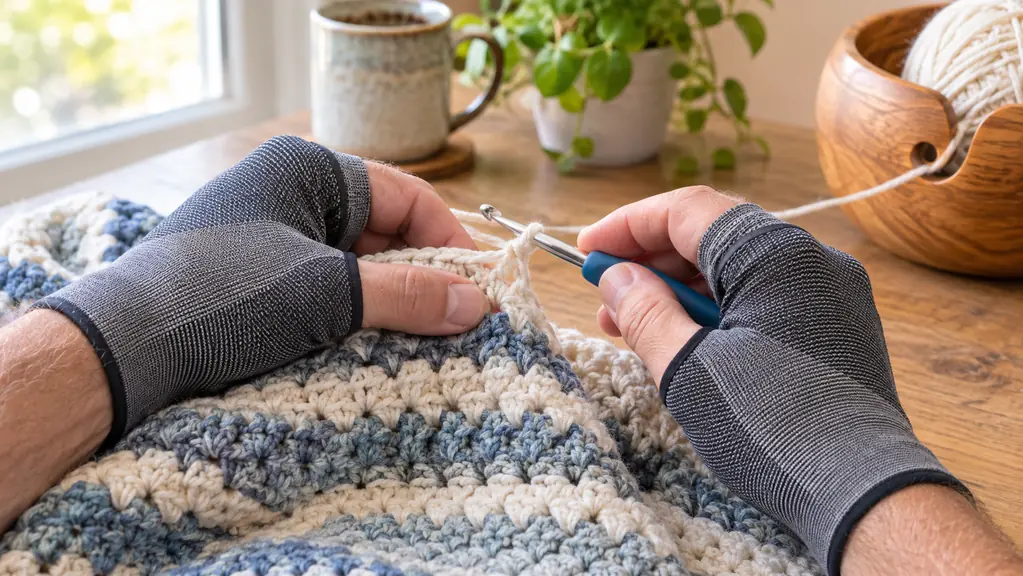
The cotton is the reason I keep reaching for it. The listing calls it lightweight with medium stretch, and that is what it feels like on, a thin layer rather than a brace. It pulls on, there is nothing to fasten, and once it is on I stop thinking about it, which is the highest compliment I can pay a piece of gear. The fingertips are cut back far enough that I can feel the hook shaft against my finger and feel the yarn running through it, so nothing about my tension changes. The compression is mild and even across the back of my hand. I do not feel it squeezing so much as I feel the absence of the ache that usually shows up around the forty minute mark.
The warmth matters more than I expected. My hands are worse in cold weather, and a Michigan February is a fair test of any glove. The cotton kept the chill off without going clammy, and I wore them for a three hour evening on a blanket headed for my church's winter drive without once pulling them off. At 1.44 ounces for the pair, the weight is not something I notice at all. What I notice is that I finish a row and start the next one instead of setting the hook down and shaking my hand out.
Where Fingerless Compression Gloves Win
Here is where the other pair earns its place, and I mean that. Compression gloves are built to do something and they do it. The drugstore pair put firm pressure across the whole hand and kept it there all evening, and if that is the sensation you want, the Dritz pair will feel like almost nothing to you. They also came in small, medium and large, which matters more than I can say for a woman with small hands and short fingers. The Dritz gloves are sold in Medium only, end of story, and mine are a little roomy on me.
I gave mine a fair trial, more than a fair one. I wore them through a whole dishcloth in October, start to finish, because a dishcloth is small and quick and I thought the pinching might ease once the knit warmed up against my hand. It did not ease. By the time I chained the last corner I was working with my thumb held out at a slight angle to keep the seam off the base of it, and that is not a way to crochet anything, least of all a corner.
The drugstore pair went in the washing machine, which the Dritz pair cannot do, since the care instruction is hand wash only and nothing else. They also cost less than the Dritz pair and could be had on any Saturday afternoon without waiting for a package to arrive. If you want to test the whole idea of wearing a glove for crochet before committing to anything, a drugstore compression glove is the inexpensive way to find out whether you like the sensation at all. That is a real use and I would not talk you out of it.
The pair that stays in the bag, not the drawer
Cotton, open fingertips, mild even compression, pull on with nothing to fasten and nothing to adjust mid row. Sold as a pair in Medium, hand wash only. Nine months of blankets, dishcloths and hats, and the one I would buy again.
Amazon Check today's price on Amazon →The Dritz pair does not fix my hands. It makes the last twenty minutes of a blanket row feel like the first twenty, and for a hobby done sitting down, that is the whole point.
What the Listing Actually Tells You
The whole design is in the product details, and it is worth reading them before you buy, because there is less there than people expect and that is exactly the point. Material: cotton. Fabric weight class: lightweight. Stretch: medium. Closure: pull on. Size: Medium, sold as two, which is one pair. Care: hand wash only. Weight: 1.44 ounces. Style number 82309, if you want to look up the exact one at the store rather than online.
Read that list again and notice what is not in it. No strap. No wrist wrap. No adjustable closure. No grippy palm. It is a cotton glove with the fingers cut back and some stretch built into the knit, and it does one thing, which is to keep your hand warm and lightly supported while you work. When I see a glove described as though it will reorganize your whole hand, I keep walking. This one makes a modest promise and keeps it, and nine months later the seams have held and the shape has held with them.
That style number is worth writing on the back of a receipt, and I say that as someone who has stood in a fabric store holding a phone out at arm's length trying to squint at a picture. 82309 is the number on the package. If you find these on a rack instead of online, you can confirm you have the same glove and not some heavier version that another company turns out for the same shelf.
For a left-hander, that plainness is one more reason to like it. A glove has no handedness, so the entire mirrored business of working right to left costs me nothing here. I put it on and crochet the way I always have, and nothing about the thing assumes my right hand is the working hand. Thirty-five years of adapting has made me notice that detail in a tool, and this one simply does not have the problem.
What a Two Hour Session Feels Like
I am working a shawl in the evenings right now, and a shawl is a great deal of the same stitch in a great many of the same row. On a mild night I work barehanded for the first twenty minutes and put the gloves on when the room cools off. By then I have settled into the rhythm of the pattern, so the trick is to change nothing. The gloves let me keep the same grip, the same tension, the same rhythm. I do not want to relearn my own hands at eight in the evening.
Take the Tuesday before Thanksgiving, cold enough that the front window had fogged by the time I sat down. I put both gloves on before the first stitch, worked a baby blanket through four full pattern repeats, and stopped at ten because Walt had the news on and I had lost count anyway. Two hours and change, no ache at the end, and I ran the same evening again on Wednesday without thinking about it.
In cold weather I put them on before I sit down, because my hands are stiffer in the cold and the first row tells the truth about how the rest of the evening will go. On those nights I wear both gloves for the entire session. On a warm July evening I usually do not wear them at all, and I would rather say so plainly than pretend they are a daily habit. Nine months in, they are a cold weather and long session tool. That is a real role without being a dramatic one.
The contrast with the compression pair shows up around minute thirty. With those, my hand felt held the whole time, and I was aware of them the way you are aware of a bandage. With the Dritz pair, awareness fades somewhere in the second row and does not come back. If you are the sort of person who wants to feel support working, you will read that as a downside. If you are the sort who wants to forget the equipment, it will not be.
What I Liked
- Cotton, lightweight, medium stretch, so it feels like a layer rather than a brace
- Fingertips cut back far enough that my grip and tension do not change
- Mild, even compression across the back of the hand
- Pull on with nothing to fasten and nothing to adjust between rows
- Warm enough for a three hour evening without going clammy
- 1.44 ounces for the pair, light enough to forget entirely
Where It Falls Short
- Sold in Medium only, and Medium runs roomy on small hands
- Hand wash only, every couple of weeks at my kitchen sink
- No firmer option for anyone who wants real pressure across the hand
- The palm is plain cotton, so a metal hook still feels slick when my hands are warm
The Fit Question
Medium is the only size, and it is a little roomy on me. I am small framed and my hands are not large. The glove does not slide off, because there is enough stretch in the knit to hold it at the wrist end, but there is extra fabric across the back of my hand that a true small would have taken up. I mention it because if your hands run smaller than mine, that extra will be more than a little. A compression glove sold in a proper small is worth looking at first in that case, even if the fit tradeoff goes the other way for you.
That extra shows up as a soft fold across the back of my hand when I make a fist around the hook. It does not bunch into my palm, which is what would actually bother me, and it does not creep down toward my fingers as I work a row. I push the cuff up snug once when I put them on and it stays where I put it. Hands a full size smaller than mine would find that fold a nuisance rather than a nothing.
I hand wash mine about every two weeks at the kitchen sink, roll them in a towel, and lay them flat on the counter to dry. Nine months of that and they have kept their shape, and the cuffs still hold. It is not a hardship, but it is a chore, and I would be fibbing if I said I never wished I could toss them in with the dishcloths. If machine washing matters to you, the Dritz pair will annoy you and a compression pair will not.
Who Should Buy Which
Buy the Dritz Crafters Comfort Gloves if you crochet in a chair for an hour or more at a stretch, if your hands get cold and stiff in the winter, if you want the lightest possible layer that does not change how you hold the hook, and if Medium is going to fit you or come close enough. That is my situation, and it is why they are in my bag instead of my drawer. It is also the pair I would hand to a friend who has never tried a glove at all.
Buy a fingerless compression glove instead if you want firm pressure rather than a light layer, if you have very small hands and need a true small, if machine washing is a dealbreaker, or if you are not sure a glove is for you at all and want to spend as little as possible finding out. Both are honest tools and neither one will do anything beyond what a glove can do. I would rather say that plainly than dress it up, because a return costs you more time than a straight answer.
A light cotton layer with the fingers cut back, for the hour that gets long
Sold as a pair in Medium, mild even compression, pull on with nothing to fasten, hand wash only. If you have been working barehanded for an hour and paying for it the next morning, this is the low risk experiment to run.
Amazon Check today's price on Amazon →