
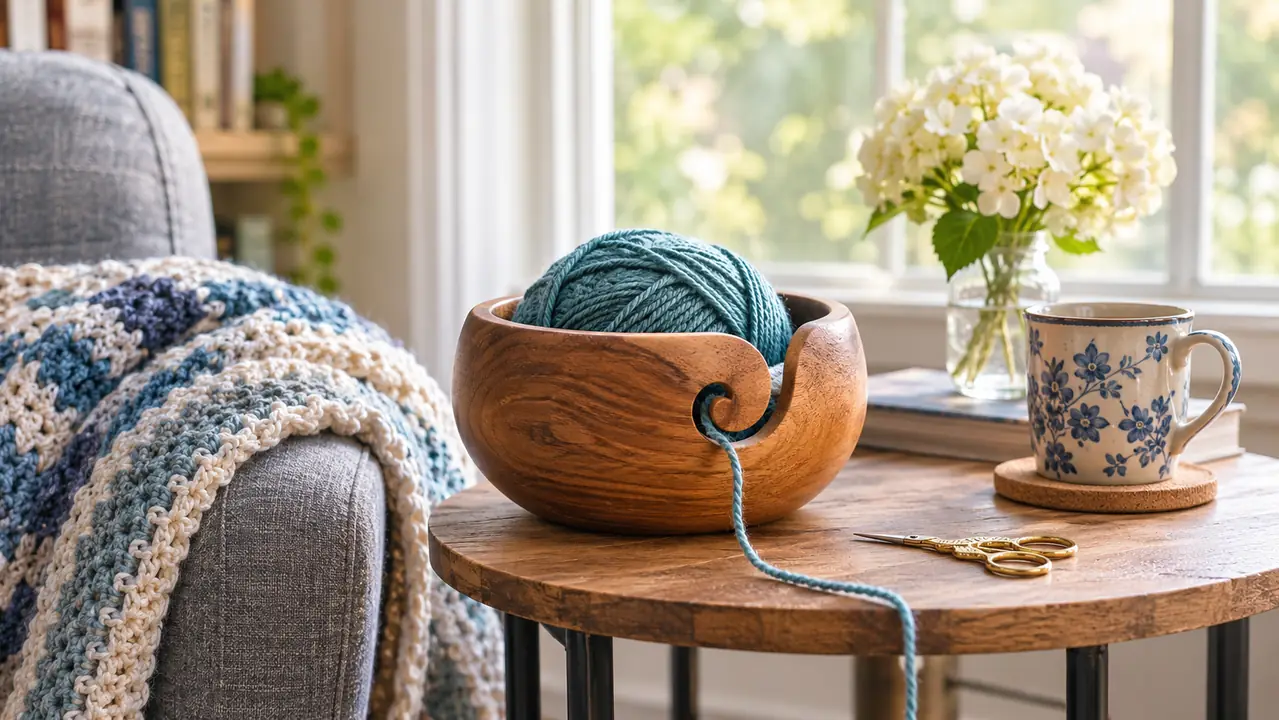
Every crocheter I know has lost a ball of yarn to the floor. Mine used to roll off the side table, past the footrest, and come to rest against the baseboard where I could not reach it without standing up. By the time I got down there, the strand had wrapped around the chair leg twice and there was a knot in it the size of a grape. I put up with that for about thirty years, which is longer than I would like to admit. Then in December 2025 I bought a Little World wooden yarn bowl, set it on the table to my right, and the ball has not touched the carpet since.
The bowl itself is a simple thing. It is about 6 inches across and 3 inches tall, it weighs 13 ounces, and the surface is smoothed so the strand slides rather than catches. One standard 3.5 ounce ball of yarn fits comfortably inside. It is not a gadget and it does not do anything clever. What it does is hold the ball in one place so the yarn comes off at a steady rate instead of being dragged across the room. That is the whole trick of it, and it is worth understanding before you spend anything, because a bowl in the wrong spot is no better than a ball on the table.
One bowl, one ball, no more crawling under the chair
Little World's wooden yarn bowl is 6 inches across and 3 inches tall, sized for a standard 3.5 ounce ball, with enough weight to stay put on a side table.
Amazon Check Today's Price on Amazon →Why a Loose Ball Causes More Trouble Than It Looks
When a ball of yarn sits loose on a table or the floor, three things go wrong at once. The ball rolls, so the distance between the ball and your hand keeps changing. The strand drags sideways across whatever it is resting on, which adds friction in one direction and none in the other. And the ball unwinds from the outside, so the outer layers go slack and slide over each other. Slack, plus uneven friction, plus a changing distance is exactly how a tangle forms. It is not bad luck and it is not the yarn.
A bowl does not fix poor yarn and it will not wind a skein for you. What it removes is two of those three problems. The ball cannot roll away, and the strand pays out at a consistent angle instead of sawing across the chair arm. The third problem, the slack, is yours to handle in step one, and that is the step most people skip because they want to get on with the pattern.
Step 1: Wind or Reset the Ball Before It Goes In
A yarn bowl will hold a tidy ball. It will also faithfully hold a collapsed mess and feed you tangles all evening, so look at the ball before it goes in. If the skein has already slumped into a soft pile, or the outer layers are loose enough to slide, rewind it first. I wind by hand, no winder, because that is what I have and because a hand wound ball has a bit of give that feeds better than a hard machine ball. It takes a few minutes at the kitchen table and it is the difference between a calm evening and a fight.
Size matters here, and the honest number is 3.5 ounces. That is what fits comfortably, and comfortably is the word to hold on to. If you have to press the ball down to get it in, it is too big for the bowl. A jumbo skein straight from the store will not go in at all, and forcing it means the strand has to drag over the rim, which is worse than using no bowl whatsoever. Step four covers what to do with the big ones.
One thing before you set it down. Find the outside end and lay it against the ball rather than letting it dangle off the edge. If the end is buried, dig it out now, in good light, at the table, not later in the armchair with half a row done. I have made that mistake more than once and it costs more time than the winding does.
Step 2: Put the Bowl Where Your Yarn Hand Already Reaches
This is the step that decides whether the bowl helps you or annoys you. Do not put it where you think it should go. Put it where your yarn hand already goes when there is no bowl, because that is the path your arm has been taking for years and you will not relearn it now. For me that is the small side table to my right, at roughly the height of the chair arm. For a right-handed crocheter it will be the left side. Same idea, mirrored.
I am left-handed and I work right to left mirrored, so nearly every diagram, pattern chart and tool demonstration is backwards for me. I taught myself from a library book at 29 by propping it in front of a mirror. The bowl was the rare piece of equipment that needed no translation, because a bowl does not care which hand pulls the strand. It only has to sit on the side the yarn comes from.
Keep it off your lap. A bowl on a lap slides when you shift, tips when you stand, and lands on a foot. Keep it off the floor as well, because then the strand runs up over the chair arm and catches on the fabric. On the table, level, within reach of your yarn hand without a stretch. I am 5 foot 1 and my feet do not sit flat on the floor in most chairs, so there is a footstool under mine and the table sits just past it. None of that is fussy. It just means nothing is pulling at me while I work.
Step 3: Feed the Strand and Then Leave It Alone
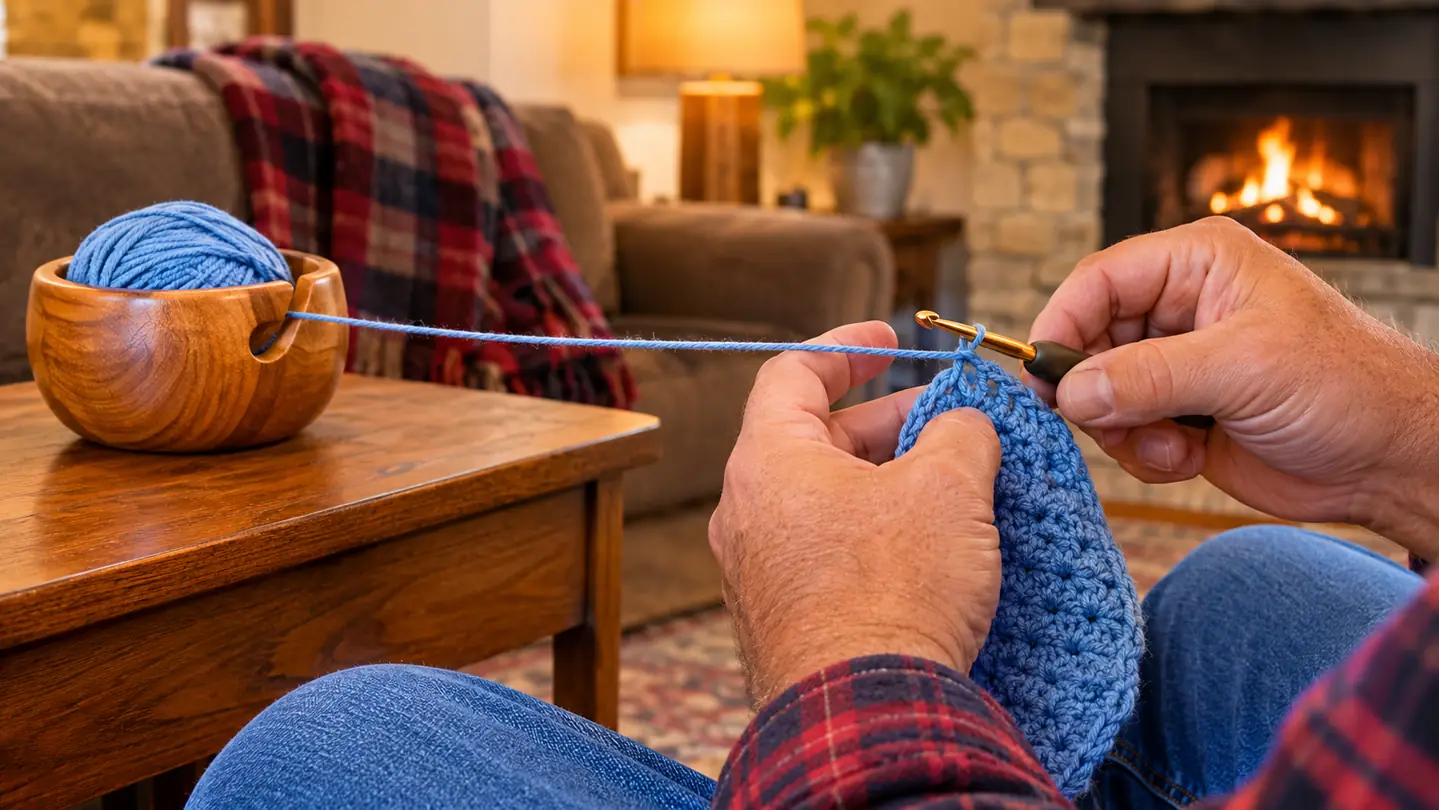
Once the ball is in and the bowl is placed, pull a length of yarn out, work the first few stitches, and stop adjusting. This is where people overcorrect. They tug the strand to test it, then tug again, and the ball hops and the tension goes uneven and they conclude the bowl is useless. Let the bowl do the holding and let your hand do the tension, exactly as you would if the ball were sitting on the table beside you.
The feel you are after is a strand that comes away with a small, steady drag. Not tight, not slack. If the strand is jumping or the ball is lifting off the bottom of the bowl, you are pulling harder than the work needs and the yarn is telling you so. Slow down for a row. It sorts itself out almost immediately.
Do not put two balls in one bowl. It looks efficient and it is not. The strands cross, one ball rides up on the other, and you spend the evening separating them instead of crocheting. One bowl, one ball. If you are carrying two colours for a striped blanket, the second ball waits in the bag or on the table until its turn.
Step 4: Deal With the Skein That Will Not Fit
Sooner or later you buy a jumbo skein, or a cone, and it does not fit. The Little World bowl is 6 inches across and 3 inches tall and it is built for a 3.5 ounce ball. A big skein will sit on top like a hat and feed badly, in fits and starts, and you will blame the pattern. My answer is to split it. Wind half into a ball that fits, work from that, and wind the rest when the first ball runs low. Ten minutes of winding saves an evening of fighting.
If splitting does not appeal, the bowl stays home and the project travels in the bag. My CRAFTISS bag has yarn slots at the top, and when I am at my daughter Beth's house for a weekend, the strand feeds through a slot instead. It is not as smooth as the bowl and the ball still shifts around down in the bag, but for a two hour visit it is perfectly fine. The bowl does the job at home. The bag does the job in the car.
What I would not do is force a big skein in and tell myself it is working. You will know within a row. The strand will come off unevenly, the tension will wander, and the blanket will show it three inches later.
I have not crawled under the armchair for a ball of yarn since December 2025. That is the entire claim, and it holds.
Step 5: Build the Rest of the Station Around the Bowl
The bowl solved one problem and made the others easier to see. The next was light. My floor lamp stands at my left, and because my left hand is the working hand, it throws a shadow straight across the stitches. In the evening that shadow is worse than the light is good. A Glocusent neck light on the warm white setting at medium brightness fixes it. It is sold as a reading light, I wear it around my neck and use it for crochet, and Walt noticed it before I did and teased me about it for a week.
The other thing was my hands. After about an hour the base of my left thumb gets stiff, and it is worse in the cold weather. I wear a pair of Dritz Crafters Comfort gloves for any session over an hour, size medium, which is a little roomy on me and I will say so plainly. They are for comfort. They are not a treatment for anything and I would not pretend otherwise. The point is that a bowl, a light and a pair of gloves turned my evening session from a scramble into a routine.
Where the bowl lives is part of that routine. It stays on the side table all year, with the current ball in it and the hook resting across the rim. It does not go in the bag, partly because it weighs 13 ounces and partly because a wooden bowl in a tote with a water bottle is asking for trouble. I broke a ceramic yarn bowl from a craft fair in 2025 when it got knocked off that same table, and I have no wish to repeat it. The wood has taken two knocks since and has not cared.
What Else Helps
If the tangles are coming from bad winding, no accessory will save you. Rewind the skein. If they are coming from the ball rolling away, the bowl is the fix. If they are coming from working in poor light, better light is the fix and it costs less than people expect. I would put those in that order, because the bowl will not compensate for a sloppy ball, and it will not compensate for a ball on the floor because the table is too far from the chair.
There are cheaper versions of the same idea. A heavy mug will hold a small ball in a pinch, and a mixing bowl with the strand taped to the rim will get you through an evening. I did the tape version for years. It works right up until the tape lets go, and then it does not. The wooden bowl is a tidier version of the same principle, with the weight to stay put and a smoothed surface where the mug handle is not. That is the honest description of what you are buying. Not a clever device. A better bowl.
Where a Yarn Bowl Stops Helping
It does not stop tangles that come from a skein collapsing on itself. It does not fit a jumbo skein or a cone. It is not something you toss in a project bag at 13 ounces and 6 inches across without noticing the weight. And it will not teach you to hold the strand more loosely, which is the true cause of half the tangles I have made in thirty five years of crocheting.
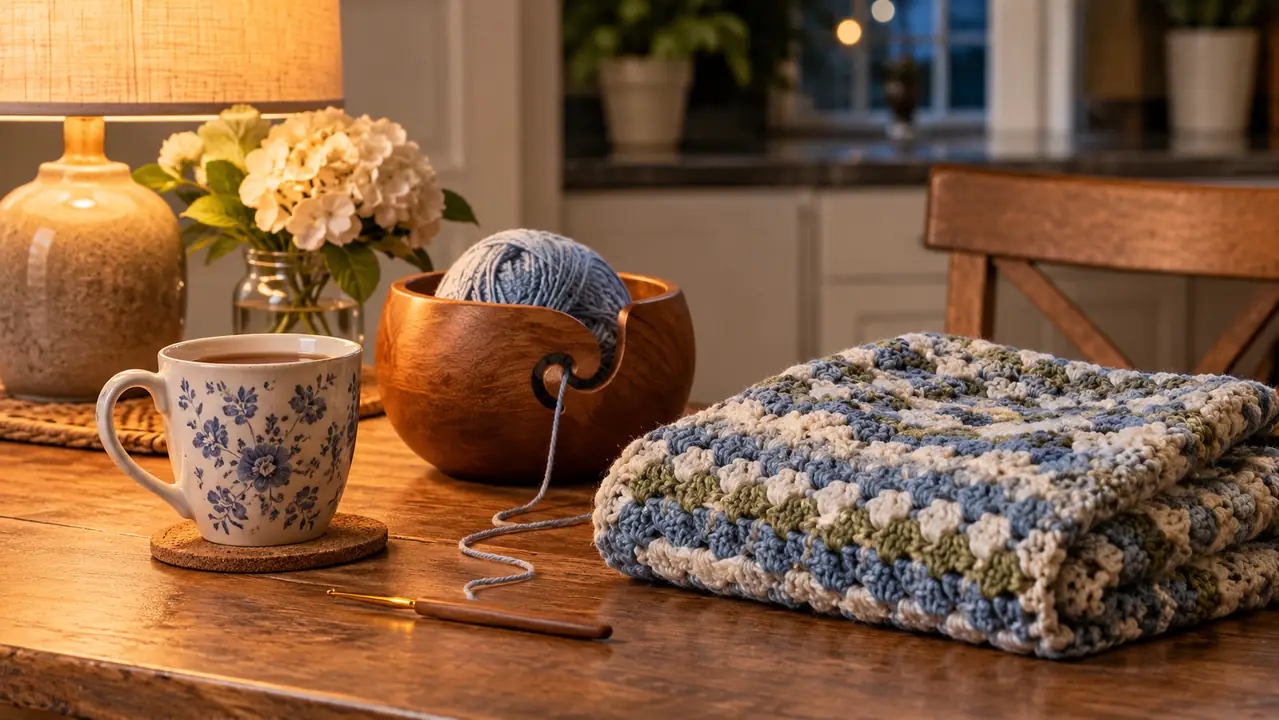
The other limit is the room. If your chair has no side table, or the table sits behind you, the bowl will end up on the floor and you will be back where you started. Measure the reach before you buy it. I got lucky. The table was already there, holding a cup and a pair of scissors, and the bowl simply took the corner of it. If you have a table within reach of your yarn hand, this works. If you do not, fix that first.
If the ball keeps rolling, this is the simplest fix in the room
Little World wooden yarn bowl, 6 inches across and 3 inches tall, one 3.5 ounce ball at a time. Mine has sat on the side table since December 2025 and has not moved.
Amazon Check Today's Price on Amazon →