
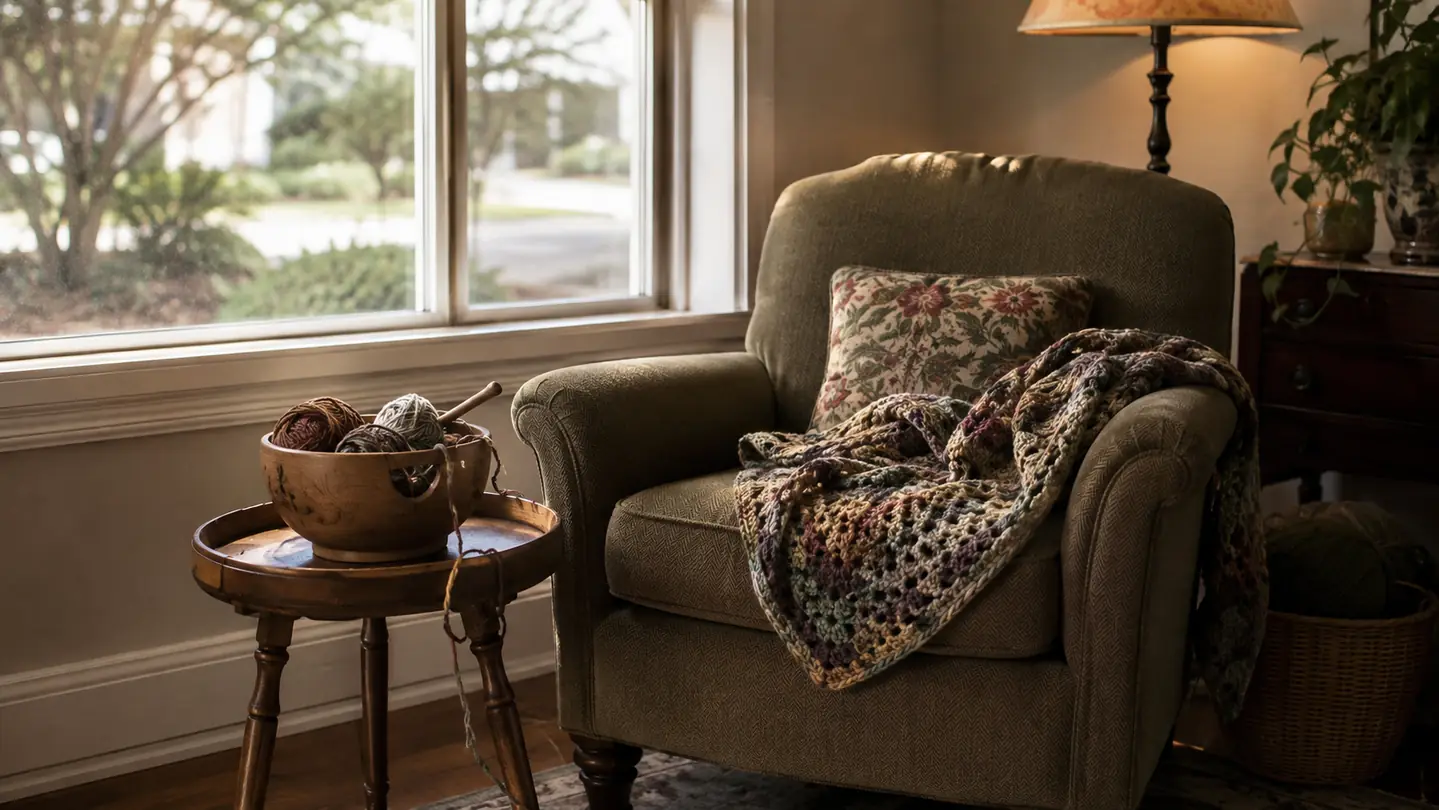
Most yarn bowl reviews are written in the first week, while the thing still feels like a purchase and not yet like a tool. I have had this one for about eleven months. That is long enough that I have stopped noticing it, which is the highest compliment I can pay anything that lives on a side table. I bought the Little World wooden yarn bowl in December 2025 for a plain reason. The ceramic bowl I kept on the table to my right got knocked onto the floor in 2025 and broke, and I did not want to spend another evening picking bits of glaze out of the carpet.
Here is the part the listing photos leave out. A yarn bowl will not make you faster. It will not fix a grip that hurts or a hand that tires. What it does is stop a ball of yarn from ending up under the chair, and it does that one job completely. I am sixty-four, I live in Kalamazoo, Michigan, and I have crocheted for about thirty-five years. I am left-handed and five foot one, so I have spent most of my crafting life adjusting tools that were built for somebody else. I will tell you which parts of this bowl needed adjusting, which parts did not, and where it falls short, because a review with no complaints in it was written by somebody who has not used the thing yet.
The Quick Verdict
One job, done completely: the ball stays put. It holds one standard skein, it stays in one room, and after eleven months it works the way it did in December.
Amazon Check Today's Price →Your yarn keeps ending up under the chair. This is the whole fix.
Six inches across, three inches tall, thirteen ounces, and room for one three and a half ounce ball. Nothing to learn and nothing to plug in.
Amazon Check Today's Price on Amazon →What the Listing Says, and What It Leaves Out
Little World gives three numbers and all three are honest. Six inches across, three inches tall, and about thirteen ounces on my kitchen scale. The listing says it comfortably fits a three and a half ounce ball of yarn, and that is exactly right: a standard skein drops in with enough room left for the ball to turn as the yarn feeds out. What it will not do is hold a one pound mill end. I tried that in January on a baby blanket for my church winter drive, and the ball sat too high to turn. I put the big skein on the floor and the bowl sat empty for six weeks, which is a fair amount of empty for a tool I like.
The finish is the part the listing undersells. It describes the surface as smoothed and high gloss, which reads like advertising until you have your hands on it. What it means in practice is that the rim is smooth and the yarn comes up out of the bowl without catching. I have run cotton dishcloth yarn through it, which is the most unforgiving yarn I use, and an acrylic baby blanket yarn, and neither one has snagged or frayed on the way out. If you have ever had a rough edge wear through a length of cotton, you know why that is worth saying out loud.
The listing also calls the bowl portable. Technically it is light enough to pick up, and I suppose that is what the word means. Mine has not left the side table in eleven months. Thirteen ounces of wood with a ball of yarn in it is a two-handed object, and the moment your yarn takes two hands to move, you have lost the reason you wanted your hands free. I am not calling the claim false. I am saying it is a sentence that only makes sense on paper.
One more thing the listing does not mention, and it is not a fault so much as a missing sentence: the inside of the bowl has no lining, no felt pad, no cork ring. It is bare smoothed wood all the way around. For me that is fine and possibly better, because there is nothing to peel up in a year. But if you have read reviews of other bowls and gone looking for a padded interior here, you will not find one. What you get is the wood, the shape, and nothing else in the box.
Eleven Months on the Side Table
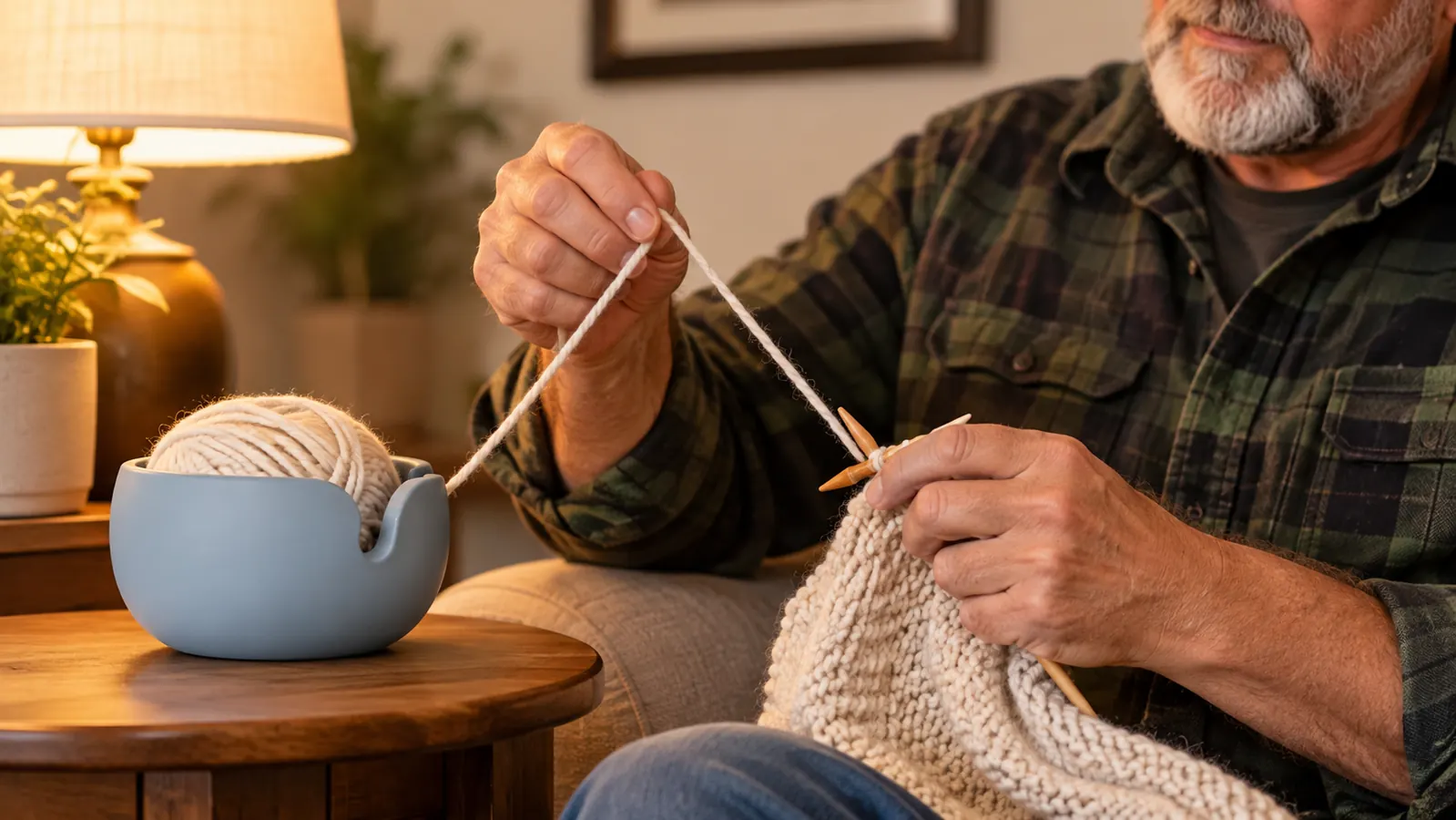
The bowl sits on the small table to my right, beside the armchair by the front window. My floor lamp stands at my left, which is where I need it, and the yarn runs from the bowl across my lap to my left hand. The first evening I used it, the ball stopped rolling under the chair. That was the whole test and it passed on day one. Eleven months later it still has not rolled anywhere, and I no longer think about it, which is the point.
Wood is a working material, so here is what eleven months has actually done to it. There is a dull patch on one side where my thumb lands when I set the bowl down or move it to dust underneath. The rim is unchanged. Nothing has split, nothing has lifted, and the inside of the bowl is as smooth as it was the week it arrived. I have not oiled it or treated it with anything. I wipe the inside with a dry cloth about every two weeks, mostly because yarn lint settles into it and the gloss makes that visible.
I did try one thing that did not help, and I mention it so you can skip the experiment. In February I ran a barely damp cloth around the inside, thinking it would lift the lint faster than dry wiping. It did lift it. It also left a faint dulled streak that took two days to fade back to an even finish. Dry cloth only, since then, and the dull patch has not grown. Whatever the gloss is, it does not want water on it, and the listing never says so either way.
The lint was the surprise. A glossed surface shows it, and a bowl that holds yarn collects a fair amount of it. That is not a flaw so much as a fact of the material. If you like a tool to look untouched, you will be wiping this one down. If you like a tool to work, you will not care.
The first evening, the ball stopped rolling under the chair. Eleven months later it still has not rolled anywhere. Everything else I could tell you is detail.
What I Compared It To Before Buying
I looked at two other options before I settled on this one, and I want to be fair to both. The first was simply replacing the ceramic bowl I had, which I had liked for years. Ceramic is heavier, and I will say plainly that a heavy bowl does not slide. That is the one place the old one beat this one. What it also does is shatter when it hits a hardwood floor, which is how I ended up shopping in the first place.
The second was a plastic bowl that a woman at the yarn shop table uses. It weighs almost nothing and it is easy to rinse out. It also moves when the yarn pulls, because there is no weight holding it down, and I watched her chase it across the table twice in one afternoon. That was enough for me. I wanted the bowl to stay where I put it, and I was willing to trade weight for that.
I spent a Saturday morning in November 2025 driving to two shops to handle bowls before I ordered anything, which sounds excessive and was not. The first shop had only ceramic, and the second had one plastic bowl and nothing wooden at all. What that trip taught me was that the shape matters more than the material: every bowl I picked up had the same single opening in the side, and the difference was only what it weighed and what it would do when it hit the floor. I ordered the Little World bowl that evening because it was the one I could afford to drop.
What I did not do was buy a bowl with a lid or a bowl with compartments. I already have a project bag with a divider and three deep outside pockets, and it does the storing. The bowl only had to feed yarn at home. Keeping those two jobs separate has saved me more annoyance over the last year than any single thing I have bought.
The Left-Handed Question
This is the shortest section in the review and that is the good news. A yarn bowl has no handedness. There is nothing on it that assumes which hand holds the hook, so there is nothing for me to work around, and after thirty-five years of scissors that cut the wrong way and tables that sit on the wrong side, that silence is a relief. I hold my hook in my left hand, the bowl sits to my right, and the yarn crosses over to me. A right-handed crocheter would put it on the other side and nothing about the bowl would know the difference.
The only adjustment was placement, and the bowl had nothing to do with it. At five foot one I sit far back in the armchair, so the side table stands higher against my lap than it would for someone of average height. Reaching over to set the bowl down and pick it back up takes more care than it ought to. What helped was moving the bowl to the front edge of the table, where my hand finds it without my having to look. Small things are most of what I notice at this point, and this one costs nothing to fix.
The Two Things That Genuinely Annoy Me
The first is the size limit, and it is the one that affects my actual work. Most of my baby blankets start life as a one pound skein, and those do not go in the bowl. So the bowl is useful for dishcloths, hats, and the shawls I donate to the winter drive, and it sits empty on blanket projects. That is a good part of the year for a tool to sit idle. I keep the big skein in a shallow basket on the floor now, which works about as well as the bowl does and cost me nothing, and that is the honest comparison nobody makes in a review: for the big projects, a basket is fine.
The second is that it does not travel, and I want to be straight with you about what that means. My project bag lives on the floor beside the armchair and rides in the car when Walt and I make the two hour drive to see our daughter, Beth. The bowl does not go in the bag. So away from home I am back to a skein on my lap or in the bag yarn slots, which works but is not the same thing. This is a home tool. Buy it for the chair by the window, not for the trip.
And a third small one, since we are being honest. I would not balance it on the arm of the chair. It wants a flat surface. In eleven months I have knocked it once while reaching for the lamp, and it slid rather than tipped, which is luck more than design. A heavier bowl would have gone over the side and I would have been back to picking up pieces.
What I Liked
- Holds a standard three and a half ounce ball with room for it to turn
- Smooth glossed surface, and cotton yarn does not catch on it
- Stopped the ball rolling on the first evening and has kept it stopped for eleven months
- No handedness to work around, nothing to adjust for a left hander
- Wipes clean with a dry cloth, no oiling or treating needed
Where It Falls Short
- Will not hold a one pound mill end
- Thirteen ounces with a ball in it means it stays put, so it is not really portable
- The gloss shows yarn lint and wants wiping every couple of weeks
- A damp cloth dulls the finish, so it is dry wiping only
- It is furniture for one room, not a travel tool
How It Fits With the Rest of My Kit
I am particular about which tool does which job, because that is how you end up with a table full of things that all half work. The bowl feeds yarn at home. The bag carries and stores. The neck light comes out after dark, when the floor lamp at my left throws the shadow of my own hand across the stitches I am trying to see. The gloves go on for any session over about an hour or on a cold morning, and they are for warmth and comfort, nothing more than that. Each one answers a different complaint.
The evenings where all of them are working at once are the winter ones. Gloves on, light around my neck on the warm white setting, hooks in the zippered case, bowl full, bag on the floor with the next project waiting in it. That is as close to a proper setup as I have managed in thirty-five years of doing this, and it took me until my sixties to get here. On a January evening last winter I finished a shawl in that chair without stopping once to fish for a ball of yarn, and I noticed the difference mainly because I had nothing to be annoyed about.
So here is the short version. If your one complaint is that your yarn will not stay where you put it, the bowl is the whole fix and you can stop reading. If your complaint is that your hand tires after an hour, a bowl will do nothing about that, and I would look at something else first.
Who This Is For
This is for someone who works in one chair, in one room, with standard sized balls of yarn, and who is tired of fishing a skein out from under the furniture. It is for the crocheter who likes wood and does not mind wiping lint off a glossed surface every couple of weeks. It is a plain wooden bowl from Little World with nothing clever added to it, and that is the appeal: there is nothing to learn here. Left-handed or right-handed makes no difference. Short or tall makes no difference beyond where you decide to set the table.
Who Should Skip It
Skip it if you buy your yarn in one pound skeins. Skip it if you crochet on the train, in a waiting room, or at a friend's kitchen table, because the bowl stays home and your bag is already doing that job. Skip it if you want one vessel to hold your hooks, your stitch markers and your yarn together, because this one holds yarn and nothing else. And skip it if a bit of visible lint would bother you more than a ball of yarn under the chair bothers you now.
Eleven months, one job, still doing it
Six inches across, three inches tall, thirteen ounces, and room for one standard ball. If your yarn keeps ending up under the chair, this is the whole fix.
Amazon Check Today's Price on Amazon →