I taught myself to crochet at 29 from a library book propped open in front of a mirror, because nobody near me in Kalamazoo worked left-handed and could show me how. For the next thirty years I used the same plain aluminum hooks. They cost almost nothing, they did the job, and if you had asked me I would have told you that a hook is a hook and the rest is marketing.
Then in September 2025 I bought the Clover Amour set, ten hooks in a box, and spent the first week feeling faintly ridiculous about it. Fourteen months later the old hooks live in a jar on the shelf and come out only when my daughter visits and wants to borrow one. What follows is the list I would give a friend at the yarn shop table if she asked me straight out whether the upgrade was worth it. No promises about your hands. Just what changed in mine.
The set I wish I had bought at 40 instead of 63
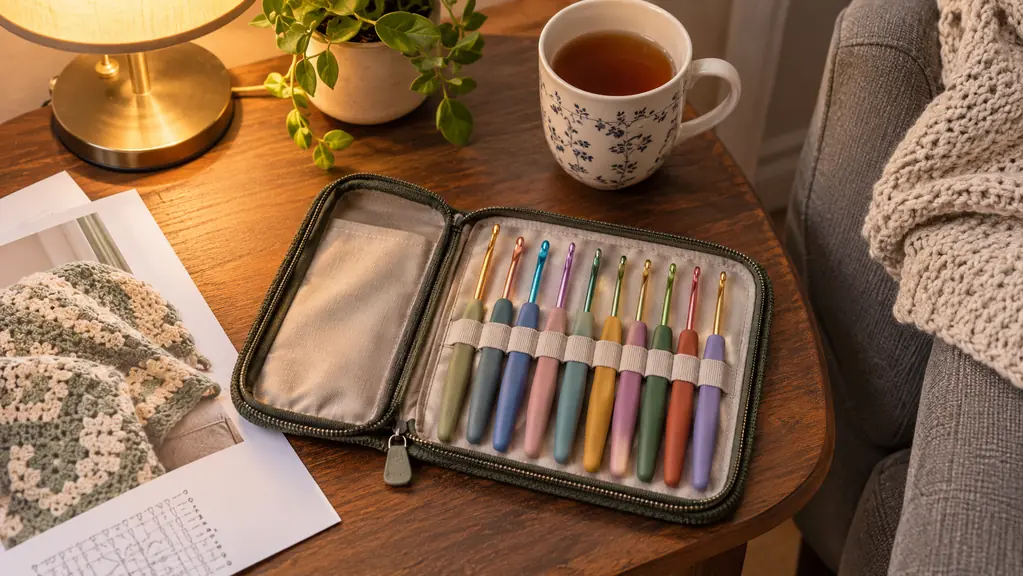
Ten hooks, B-2.25mm through J-6.00mm, with a soft warm-to-touch grip on a polished aluminum hook. Fourteen months of daily use and they are still the only ones I reach for.
Amazon Check Today's Price on Amazon →The handle stays warm in your hand, even in February
The first thing I noticed was temperature, which sounds like nothing until you have held bare aluminum for an hour in a Michigan winter. The Clover handle has a soft grip that stays warm to the touch. My old hooks were metal end to end, and my fingers curled around them the way you hold a spoon out of the freezer. It is not a feature that shows up in a photograph. It is the one I noticed first, and it is the one I would miss most if I ever went back.
A polished aluminum head that slides instead of drags
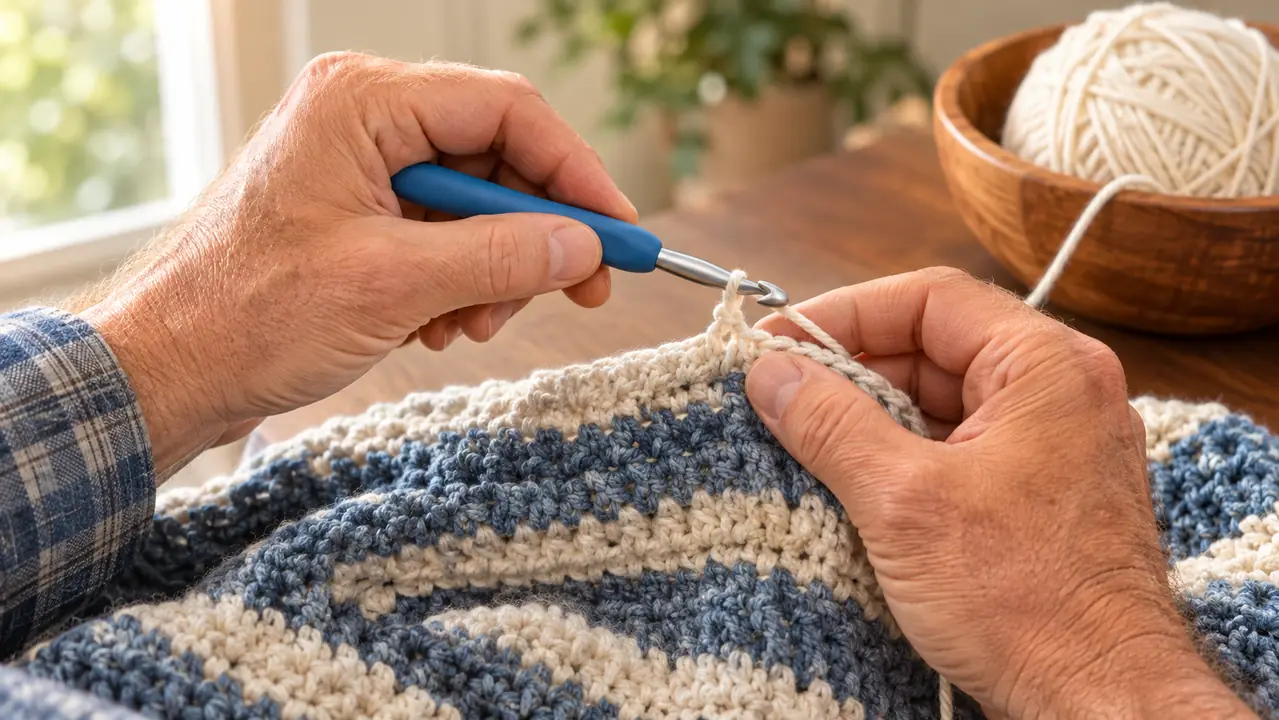
The hook end is still aluminum and still polished, which is what you want. A rough or coated hook catches the yarn and makes you tug, and tugging is what turns a twenty minute row into forty. These go through a single crochet cleanly, no squeak, no drag, no stopping to pick a split stitch apart with your thumbnail. Thirty years with plain aluminum and I did not know I had been fighting the tool instead of the pattern. My gauge got steadier too, though I cannot prove the hook is why.
Ten sizes, B-2.25mm through J-6.00mm, in one box
The set runs from B-2.25mm up to J-6.00mm, ten hooks, and that covers nearly everything I make. Dishcloths on an H-5.00mm. Baby blankets on a G-4.00mm. Hats on an I-5.50mm. Before this I owned a shoebox of hooks in sizes I could not identify because the stamping had worn off years ago, and I was guessing at gauge half the time. Now the whole range sits in one case and I have stopped improvising.
You stop hunting for the right size
Each size in the set is easy to tell from the next, and after about a month I could reach into the case and pull the G-4.00mm without looking or putting my glasses on. The size is also marked on the hook, so nothing depends on my memory. If you have ever dumped a tote bag onto the kitchen table because you needed one hook you knew was in there somewhere, you already know what that is worth.
The whole set weighs 3.3 ounces
Three point three ounces for all ten hooks, which means a single one is close to nothing in your hand. My hands are small, and a heavy hook tires my wrist faster than I like to admit. I can work a whole evening now and my grip does not feel like it has been doing curls. It also means the set adds almost no weight to a bag, which matters when you are five foot one and end up carrying everything by the top handle.
The grip is symmetrical, so left-handers need no workaround
This is the reason I am writing this list at all. Most shaped or molded handles are made for a right hand, and a left-handed crocheter spends her life turning the tool upside down or holding it at an angle nobody intended. The Clover grip is symmetrical. There is no front and no back to it. I hold it in my left hand and work right to left, mirrored, and there is nothing to adapt, reverse or learn around. That is rarer than it should be.
About twenty more minutes before my thumb asks me to stop
I will be careful here, because I am not selling you a cure and I do not have a diagnosis to hand you. What I can tell you is what happened. Within about two weeks of switching I noticed I could work roughly twenty minutes longer before I had to set the piece down and rest the base of my left thumb. In cold weather it still stiffens up, and I still put the work down when it does. Twenty minutes is twenty minutes.
They made the hooks I used for thirty years feel like work
I kept my Susan Bates Silvalume hooks. I am not going to pretend they are bad, because thirty years of blankets came off them. But when I picked one up again in October to teach Beth a stitch, it felt like holding a knitting needle with a bend in it. The difference was not in the finished fabric. It was in how much of the evening I spent thinking about my hands instead of the pattern.
It ends the drawer of orphan hooks
When you buy hooks one at a time you end up with doubles, gaps, and a size you swear you own and cannot find. One set covers the range I actually use and then some, so I have stopped buying singles at the craft store on the way home from somewhere. If you already own a full range you like, this reason does not apply to you, and I would not pretend it does.
Fourteen months in, nothing has loosened or wobbled
I have used the G-4.00mm and the H-5.00mm nearly every day since September 2025. The grips are still tight on the shafts, with no play, no chipping, and no soft spot where my thumb sits. The aluminum is still polished. That is the whole test, really. A hook either holds up or it does not, and a set you replace every year is no bargain at any number.
What I'd Skip
Two honest caveats before you decide. First, the handle is bulky. It is lovely in the hand at the armchair and it is a nuisance in a small project pouch, so if you crochet on a train with a pouch the size of a paperback, you will notice. Second, if you only ever work one weight of yarn, buy that single size instead of a set. The set earns its keep because I move between G, H and I in the same week. And if you never use thread, the smallest sizes will sit in the case looking at you. I would skip the full set and buy the three hooks you actually reach for. It also costs more than plain aluminum, which I would rather you heard from me than find out at the register.
Within about two weeks I could work roughly twenty minutes longer before my left thumb asked me to stop.
If your evenings end when your hands do, start with the size you use most
A full set of ten Clover Amour hooks, B-2.25mm through J-6.00mm, is the one purchase that changed how long I can sit and work. Fourteen months of daily use and mine still feel new.
Amazon Check Today's Price on Amazon →