
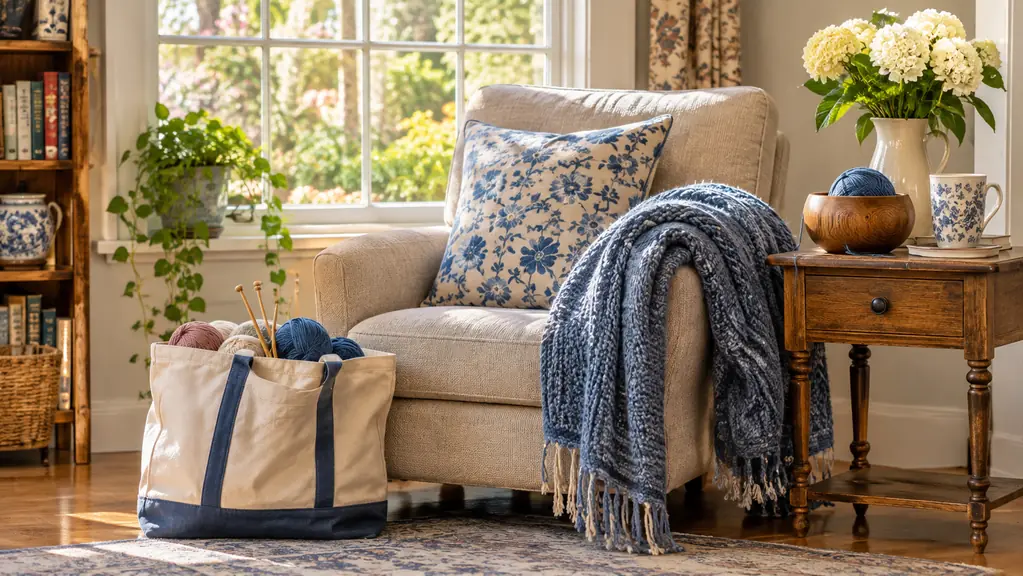
I bought the CRAFTISS project bag in May, mostly because I was tired of digging for a crochet hook at the bottom of a canvas tote. Six months later it sits on the floor beside my armchair by the front window, and it rides in the car about once a month when my husband Walt and I drive two hours to see our daughter Beth.
I am 64, retired after a long stretch working in a school office in Kalamazoo, Michigan. I have crocheted for about 35 years, taught myself out of a library book propped in front of a mirror because nobody near me worked left-handed, and I am 5 foot 1. That last part matters more than people expect. Most bags are designed for a body four inches taller than mine, and most tools are designed for a right hand. So when I say something works, I mean it works in a small armchair with a short left-handed woman in it, not that it photographs well.
The Quick Verdict
Six months of daily use and the zipper, the stitching and the handle have all held. It solved my hook-falling-to-the-bottom problem, though at 5 foot 1 the shoulder strap hangs lower than I like.
Amazon Check Today's Price →If your work in progress keeps turning into a knot, start here
The CRAFTISS bag is canvas, closes with a zipper, and holds a blanket in progress along with a hook case, gloves and a pattern. Six months in, mine is still on the floor beside my chair.
Amazon Check Today's Price on Amazon →How I've Used It
Here is the honest picture of what is in it right now. The main compartment holds a baby blanket I am making for my church's winter drive, with the working skein on one side of the divider and the growing fabric on the other. The included zippered case holds my Clover Amour hooks, the set of ten I bought in September 2025. A pair of Dritz Crafters Comfort gloves lives in one of the outside pockets. There is a folded pattern in another pocket and a small tin of stitch markers in the third.
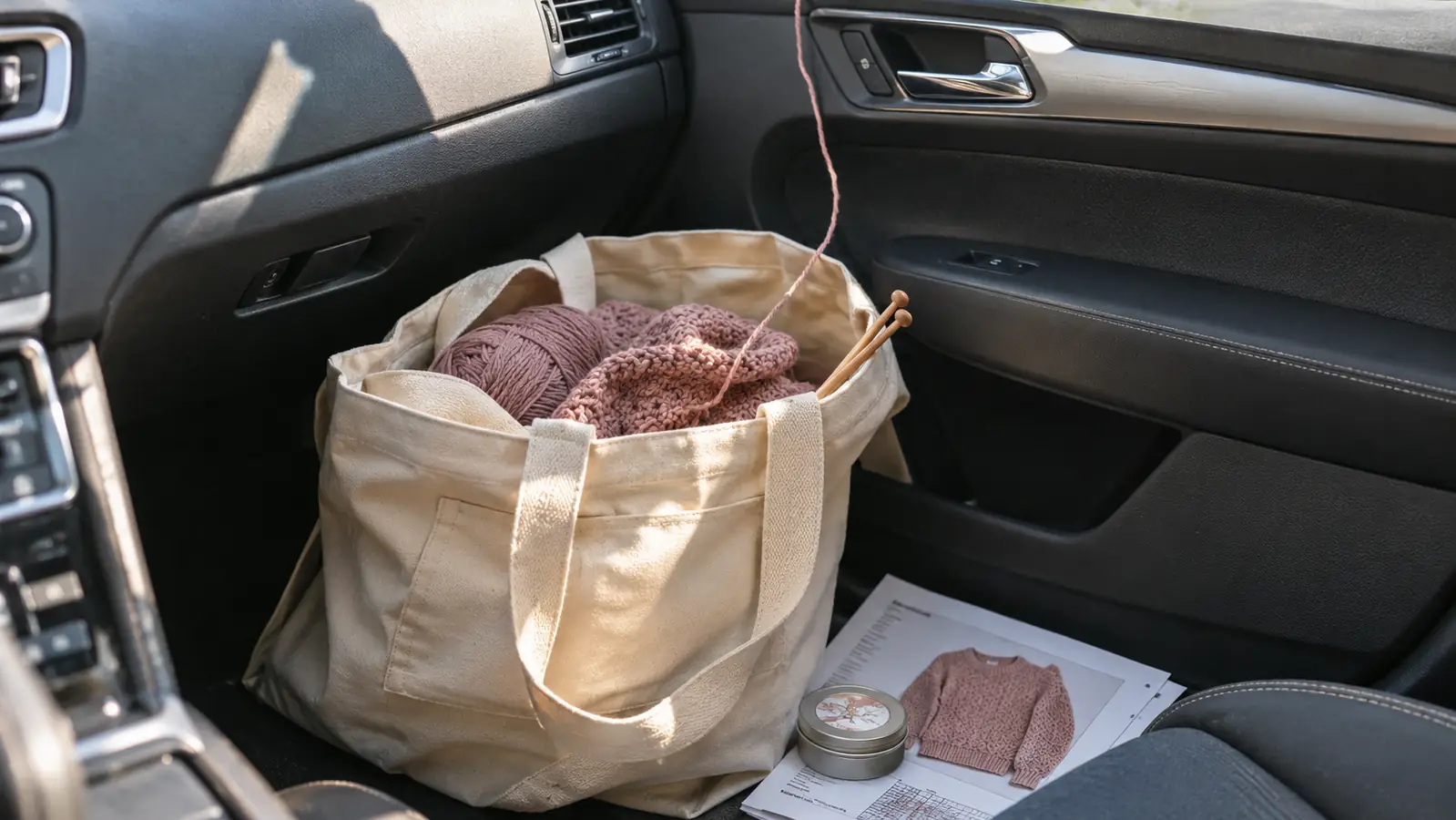
At home the bag lives on the floor beside the chair and mostly stays zipped. I do not use the top yarn slots at home, because the wooden yarn bowl on the side table to my right does that job better and has since December. The slots come into their own when I am away from the house. On the drive to Beth's I feed the working skein through a slot, set the bag on the passenger floor, and the yarn comes up without the ball rolling under the seat.
Six months is long enough to stop being careful with a thing. This bag has been set down on a hardwood floor, a kitchen table, a church fellowship hall floor and a car floor mat. It has been picked up by the top handle while I was holding a coffee in the other hand. Nothing has pulled loose, and I have not had to think about it once.
One Saturday in September I packed it in about four minutes. That number is not a boast, it is the whole reason I bought the thing. A blanket, the hook case, the gloves, a printed pattern with my pencil marks all over it, and a bag of yarn ends I keep meaning to weave in. Everything went into the correct compartment on the first try, because there is a place for each thing. In the tote years that same packing job took three tries and one walk around the house looking for the H-5.00mm hook.
The Divider Is the Point, and I Was Skeptical
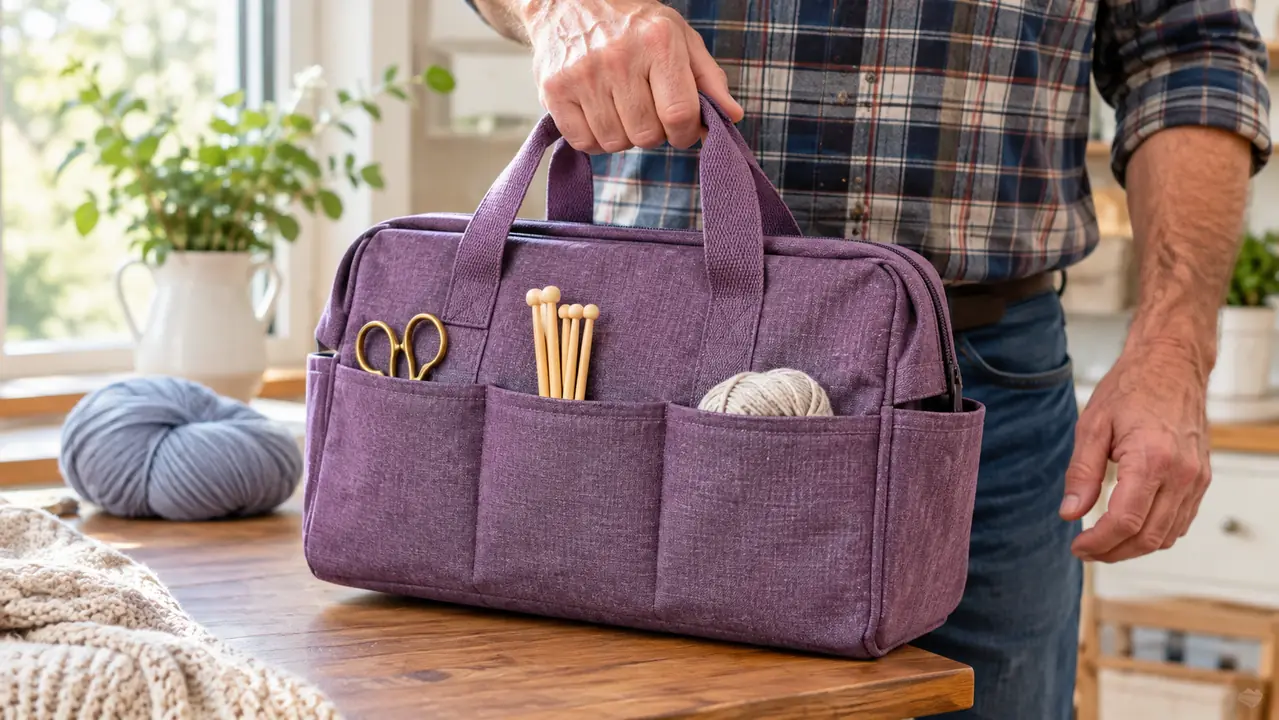
When I ordered it I figured the removable divider was a marketing line. I have been wrong about smaller things. With the divider in, the main space splits into separate sections, which means the working yarn and the finished fabric do not tangle into each other every time I set the bag down. For years my library tote turned a half-finished dishcloth into a knot by the time I got out to the car.
The divider lifts right out. Pull it and you have one open space, which is what you want for a larger skein or a cake that will not sit happily in a half. I have done that twice, once for a shawl and once for a blanket I was making in a heavier yarn. It goes back in easily. There is no trick to it and nothing to line up, which matters when your hands are stiff at the end of an evening.
Four compartments in total, counting the two divider sections and the outside pockets. For a woman who spent decades with one undivided tote, that sounds like a small thing. It is not. It is the difference between reaching for the H-5.00mm hook and emptying the whole bag onto the armchair to find it.
A caution from experience. The first time I pulled the divider out for a heavier blanket yarn, I did not put it back for about three weeks. By then the working skein and the finished fabric had made friends, and I spent a whole evening working a strand back out of a row of stitches I had already closed off. That is the cost of the open space. The divider is not decoration, it is what stops that from happening, and now it goes back in the same day.
The Three Outside Pockets Earn Their Keep
Three deep outside pockets, and they are deep in a way that matters. My hooks go in the zippered case and the case goes in a pocket, so I am not hunting. My gloves go in another. The third holds a pattern and a pen. Because the pockets are on the outside, I can get a hook out without opening the top and disturbing the project I just squared away.
This solved my actual complaint about the canvas tote I used for years, which was that everything small migrated to the bottom and stayed there. Hooks, needle gauges, the little scissors. You would think any bag with a pocket would fix that. It only fixes it if the pocket is deep enough that things do not slide back out when the bag tips over in the car, and these are.
The pockets are also cut so things settle rather than float. Walt handed me a pair of small scissors last month and they went into the third pocket upright, where I could get two fingers in and pull them straight out. Nothing has slid back out when I set the bag down harder than I meant to, and on a hardwood floor I have done that more than once.
The included zippered case is worth naming separately. It is small, it closes, and it holds the Clover set with room left over. Before this, my hooks lived loose in a drawer and I would take the whole set out to find the one I wanted. Now the case comes out, I take the G-4.00mm, and the drawer stays shut.
Six Months Later: Zippers, Stitching and That Handle
The zipper is the part I expected to fail first, because zippers on ordinary bags always do. It has not. I zip and unzip this bag several times a day, more when I am going out, and the pull still moves smoothly and the teeth still meet. The stitching where the handle attaches shows no fraying. That is the seam that carries the whole weight of a loaded bag, so it is the one I check. The one habit I have picked up since May is closing it before I lift it. Not because the bag needs it, but because a loaded bag with the top open tilts and dumps a skein on the floor.
One thing worth knowing: CRAFTISS offers a five-year warranty on zippers, stitching and hardware once you register the bag. I registered mine in May, which took a few minutes at the kitchen table. I have not had to use it and I hope I never do, but a five-year promise on the parts that actually fail is a different thing from a promise on the parts that never do.
The bag weighs about 1.4 pounds empty and measures roughly 10 by 10 by 12 inches, which is about 1000 cubic inches. That number meant nothing to me on paper either, so here is the translation: it holds a baby blanket in progress, a full set of ten hooks in a case, a pair of gloves, a paper pattern and a tin of markers, and it still zips without a fight.
I keep a small notebook on the side table to track what goes to the church drive, and since the bag came into the house in May I have finished thirty-eight dishcloths and four baby blankets. Most of those spent time in it, which means the zipper has opened and closed a few times for each one. That is a lot of travel for six months. I looked the pull tab over again in October and it is the same as it was in June.
I am 5 foot 1, and at that height the shoulder strap hangs lower than I like, especially with the bag loaded. I carry it by the top handle most of the time, and the handle is comfortable enough that I do not mind. When I do use the strap I take a shorter grip on it. A taller friend would not think about this at all, and I want to be fair about that.
What It Doesn't Do
It does not feed yarn. That sounds obvious, but I want to be plain about it, because a bag and a yarn bowl get described in similar language and they do different jobs. At home the yarn comes out of the wooden bowl on my side table and the bag just holds things. The top slots are for when I am out of the house.
It is not rigid. Canvas with a zipper, in a large size, will slump when it is half full, and it will not stand up on its own on a car floor. That has not bothered me at all. If you want something that holds its shape no matter what is inside it, this is not that, and I would rather tell you now than have you find out on your own.
With the divider in place, each half is narrower than the whole bag. A regular skein or cake fits fine. You will want to pull the divider out for anything large. That is not a flaw exactly, it is how the design works, but it is the thing I have had to adjust to most often and the thing I would tell a friend first.
The canvas itself is not waterproof, and I would not set it down on wet ground. Nobody told me it was, and I am not complaining, but a Michigan driveway in November is a Michigan driveway in November. When it is really coming down I carry the bag under my coat to the car, which looks sillier than it sounds at 5 foot 1.
And it will not sort your yarn for you. I have a bad habit of buying a skein for one project and then starting another before the first is done, and the bag will hold both of those projects quite happily in its separate sections without ever telling me to finish one before I begin the next. That is on me. It is not a fault of the bag, but I would be lying if I said six months with it had made me any more disciplined about that.
What I Liked
- The divider keeps the working yarn from tangling into the fabric you already made
- Three deep outside pockets mean hooks and gloves stay reachable without opening the top
- Zipper and the handle stitching have held through six months of daily use
- Holds a blanket in progress, a full hook set, gloves and a pattern with room to zip
- The included zippered case keeps a set of ten hooks together
- Five-year warranty on zippers, stitching and hardware after registration
Where It Falls Short
- Shoulder strap hangs low on a 5 foot 1 frame, so the top handle gets most of the use
- Canvas slumps when the bag is half full and will not stand on its own
- The two divider halves are narrow, so a larger cake needs the divider removed
Six months, several hundred zips, and the seam that carries the entire bag has not frayed once. That is the only durability test I actually trust.
Who This Is For
This is for someone who carries a project around, even if the carrying is only from the living room to the kitchen. If your hooks live loose in a drawer and your work in progress lives in a tote where it turns into a knot, the divider and the outside pockets will change your evenings. It suits knitters as well as crocheters, since a knitting needle and a crochet hook have exactly the same disappearing problem.
It is also a good fit if you take a project out of the house, to a class or a friend's table or a church hall, and you want the yarn to feed from the bag instead of rolling across the floor. And it makes sense for anyone who has bought three totes in two years and is tired of replacing them. The CRAFTISS bag is the first one I have owned that I expect to still be using next spring.
Who Should Skip It
Skip it if you work in one spot and never move your project. My wooden bowl does the feeding and my chair does the sitting. The bag earns its place because I go out about once a month and because I like the small parts contained. If everything stays on one table, a bowl and a small case would do the same work without another bag in the house.
Skip it too if you want a bag that stands up by itself, or if a low shoulder strap on a short frame would drive you up a wall. And if you already own a tote you love, with pockets deep enough that hooks do not fall to the bottom, then you do not have the problem this bag solves and you can save yourself the shelf space.
Six months in, it is still on the floor beside my chair
Canvas, zipper closure, removable divider, three deep outside pockets and an included zippered case. If your work in progress keeps sliding into a knot, this is the fix I found.
Amazon Check Today's Price on Amazon →