
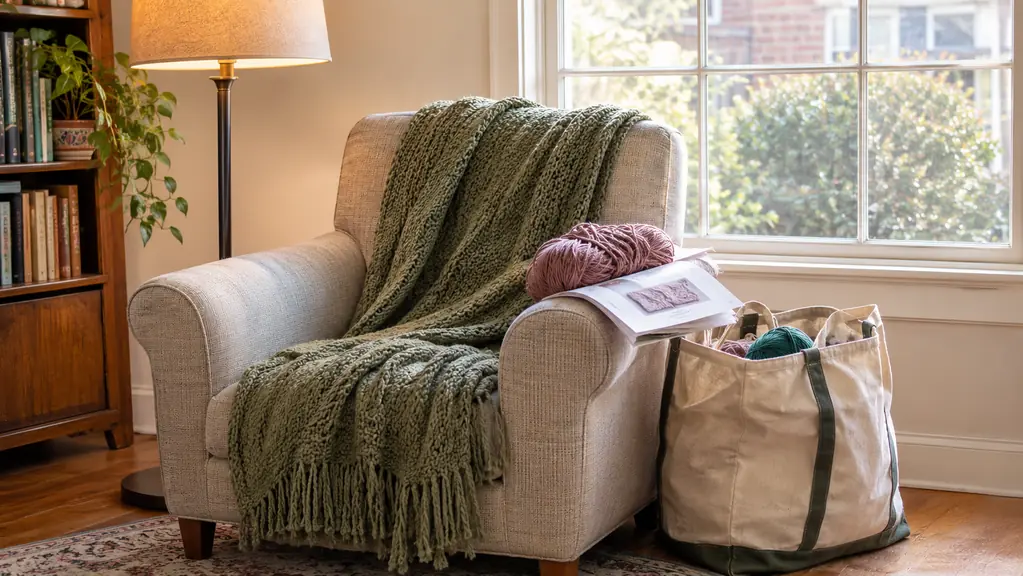
Short answer first. If your project leaves the house, or moves from the armchair to the kitchen table and back again, the CRAFTISS crochet bag is the better tool for the job. If your crochet lives in one chair with a basket beside it and never travels anywhere, a plain tote bag is fine and you should keep your money. That reads like fence-sitting. It is not. Those are two different jobs, and I have done both of them for years at a stretch. I am 64, left-handed, 5 foot 1, and I crocheted out of a free canvas library tote for most of three decades before I bought anything made for this work. The tote was not a bad bag. It was a bag with no opinion about crochet, and that turned out to matter more than I expected.
What finally pushed me was a hook. Every hook I owned ended up at the bottom of that tote, under the yarn, under the pattern folder, under a paperback. Every session began with me stirring the bag like a flour bin, and every session ended with me dropping the hook back into the same place it would be lost from. In May 2026 I bought the CRAFTISS bag. It is canvas, size large, about 10.23 by 10.23 by 12.2 inches, with a zipper closure across the top, a removable divider, three deep outside pockets, an included zippered case, a shoulder strap and a top handle. It weighs 1.4 pounds empty and it is rated at 1000 cubic inches of capacity. Six months of daily use later, here is the honest head to head.
| CRAFTISS Crochet Bag | Plain canvas tote bag | |
|---|---|---|
| Compartments | Four, plus a removable divider | One open cavity |
| Closure | Full zipper across the top | Open top |
| Hook storage | Included zippered case plus three deep outside pockets | Hooks loose at the bottom |
| Carrying | Shoulder strap and a top handle | Two stitched strap handles |
| Warranty | Five years on zippers, stitching and hardware with registration | No warranty |
| Empty weight | 1.4 pounds | A few ounces, barely there |
| Money | Real money for a bag | You probably already own one |
| Disappears in a room | Reads as a craft bag and stays out | Looks like nothing, goes anywhere |
| Capacity and size | Fixed and known: 1000 cubic inches, 10.23 by 10.23 by 12.2 inches | Varies wildly, often roomy but shapeless |
I scored each row on what it does for a person actually crocheting, not on how the object looks on a shelf. Three rows go to the tote and I will defend every one of them below. A comparison where one side wins everything is an advertisement, not a comparison.
Where the CRAFTISS Bag Wins
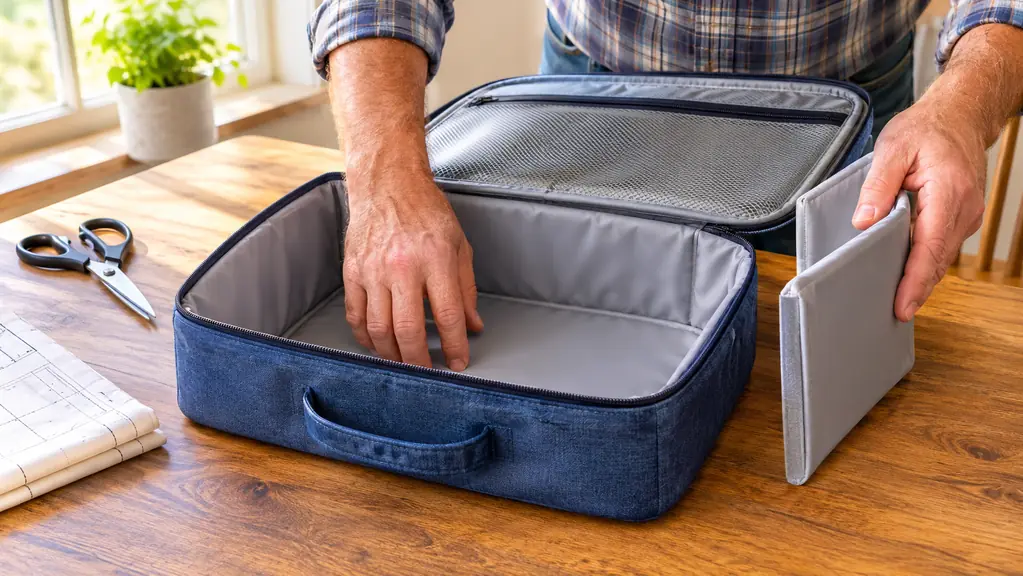
The divider is the part I would pay for again. It lifts out, which matters more than it sounds. In place, the bag is four compartments. Lifted out, it is one open space. I use it both ways about equally. Dishcloths and hats stay separated by project when the divider is in, which means I stop carrying three projects at once and finishing none of them. When a baby blanket gets big enough to argue with, the divider comes out and the whole bag becomes one deep well. That happened for real in the middle of July. The blanket I was working on, a shell stitch in a soft worsted, measured about 34 inches across by then and would not fold into half the bag any longer. I lifted the divider out on a Tuesday evening, set it on the side table, and the blanket went in without a fight. That divider sat on that table for five weeks. When the blanket was finished and blocked, it went back in and the bag was four compartments again in about four seconds. Nothing is glued, nothing is stitched shut, and nothing about the arrangement is permanent. A plain tote is permanently in that second state. That is not a flaw exactly, but it is the difference between a bag that adapts and a bag that simply holds things while gravity sorts them.
At 5 foot 1, the shoulder strap hangs the bag low on me, near my hip, and it swings when I walk. The top handle is what I actually use. That sounds like a small thing to put in a comparison. It is the reason the bag comes into the house instead of living in the car for a week. The bag rides to our daughter Beth about once a month, two hours each way, and it goes in by the handle, sits on the floor of her guest room, and comes back out the same way. My old tote had two stitched straps and no handle, and it stayed in the car more often than not, because carrying it any real distance was a chore.
The included zippered case solved the hook problem on the first evening. One case, all the hooks, no stirring. The three deep outside pockets take what I want without unzipping anything: the Dritz gloves in one, scissors in another, a folded pattern in the third. None of that exists on a plain tote. A tote gives you one cavity and gravity, and gravity always wins with a 4.00mm hook. There is also a five-year warranty on the zippers, stitching and hardware if you register the bag, which is a strange thing to find on a craft bag and a useful one. I have not needed it. Six months of a zipper being pulled open and shut twice a day has not produced a single skipped tooth.
Where a Plain Tote Bag Wins
Weight and money, and I will not pretend otherwise. A plain canvas tote weighs a few ounces and you probably already own one. The CRAFTISS bag is 1.4 pounds before a single skein goes in, and at my size that is real weight on one shoulder after a block of walking. If you walk to a weekly group six blocks away, you will feel the difference by the time you arrive, and you will feel it most in July. In January I do not notice it at all, because I am not standing outside in it. There is also the arithmetic of it. A tote is free with a library card or a conference. The bag is a purchase, and it is a purchase you make for order rather than for beauty. I bought it because I was tired of hunting, not because the tote failed me. If your budget this month is one thing, I would spend it on a good hook before I spent it on a bag. That is the honest order of operations, from someone who owns both. That is the whole of the weight and money argument, and for some readers it ends the discussion right there. It should, if walking is how you get to your crochet.
The tote also has no opinions, and there is a kind of freedom in that. You can drop a magazine, a sandwich, three skeins, a water bottle and a pair of scissors into a tote and nothing objects. The CRAFTISS bag is organized, and organized means it asks you to put things where they belong. On a tired evening that is a small amount of work the tote never requests. Last December I used the tote for the church winter drive and it held eight donated hats, a bag of skeins and a pair of scissors with room left over for my gloves. I carried it against my chest with both hands the way you carry a laundry basket, and it did not complain once. You cannot do that with the new bag. Its handles are a shoulder strap and a top handle, and both of them want one hand or one shoulder. So the tote still does the hauling, and I expect it always will. I keep it folded on the shelf by the door for exactly that errand. The bag is for my project. The tote is for a haul. Those are not the same errand, and I would not want to give up either one.
Four compartments, one case, and no more digging for a hook
Canvas, zipper closure, removable divider, three deep outside pockets and an included zippered case. 1000 cubic inches of capacity, 10.23 by 10.23 by 12.2 inches, 1.4 pounds empty. Five-year warranty on zippers, stitching and hardware with registration.
Amazon Check Today's Price on Amazon →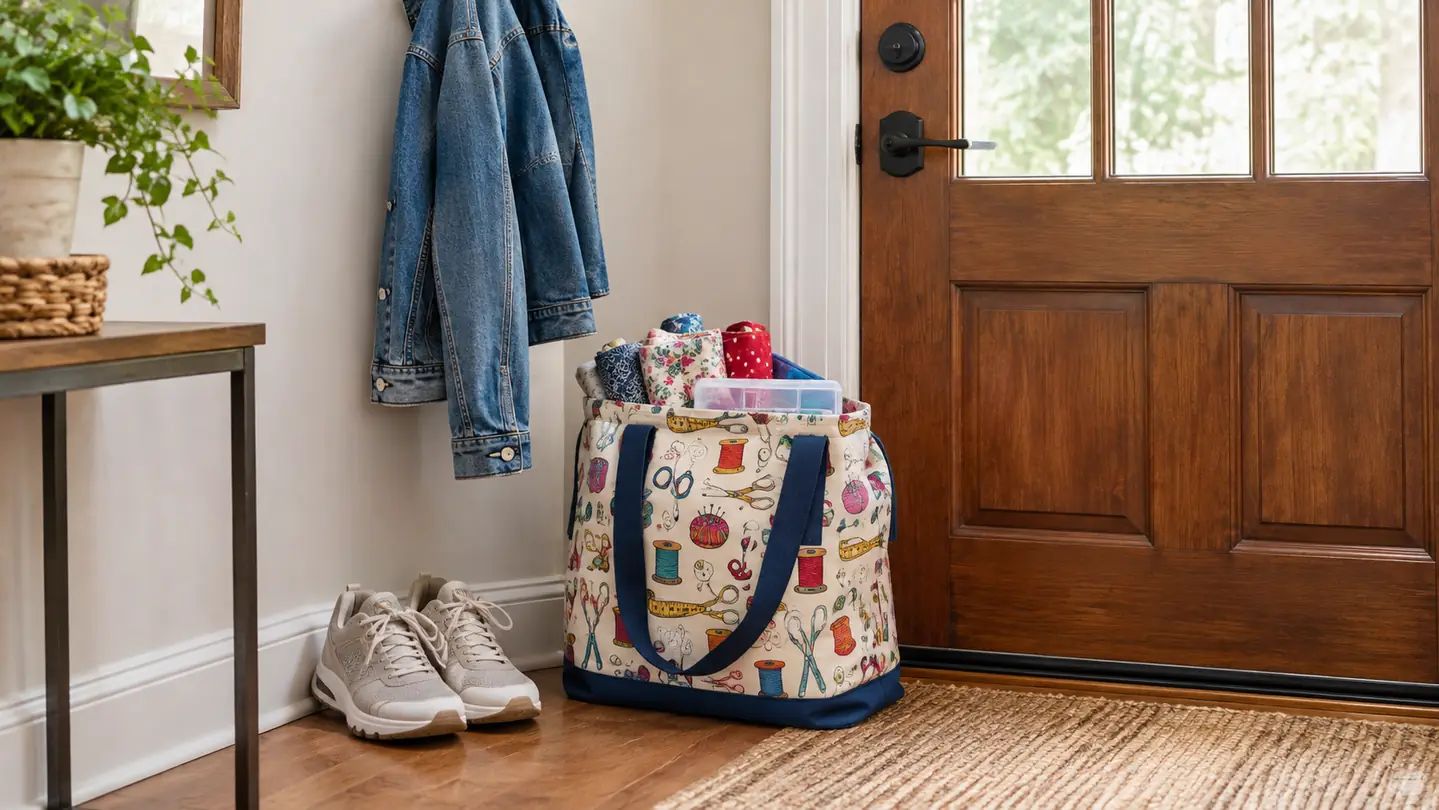
Six Months In: What Held Up and What I Watch
Six months is long enough to be honest about wear. The canvas has softened and gone slightly limp at the base, which I like, and which also means the bag no longer stands up on its own when it is empty. The zipper pull has a small scuff on it. The divider has stayed stiff, which is what you want, because a divider that sags stops dividing anything. The stitching at the top handle is where I would expect trouble, since that is the part I pull on, and it has not moved. I check it about once a month, the way I check the strap on anything I carry by a single point. So far there has been nothing to find. That is a boring report and a good one. In September I did something specific. I turned the bag upside down over the kitchen table and shook it, the way I used to shake the tote, and what came out was a pencil stub and a single stitch marker. With the tote that same shake used to produce two hooks, a metal needle gauge and a grocery receipt. That comparison took me four seconds and told me more than six months of looking at the bag had.
What I watch for is the outside pockets, because deep pockets on a soft canvas bag can stretch out of shape. Mine hold gloves and scissors, not weight, so they have kept their shape. If you fill yours with skeins, I would expect them to sag within a year. That is a guess and not a finding, and I would rather say so than pretend I know. I also empty the bag onto the kitchen table once a month and sort it, and that small ritual is the only reason the divider still works. Organization you do not maintain is just a bag with more places to lose things in.
One case, all the hooks, no stirring. That was the whole fix, and it cost me one evening of moving things from one bag to another.
Who Should Buy Which
Buy the CRAFTISS bag if your project travels. That covers more people than it sounds like. If you carry work to a weekly group, to a waiting room, to a daughter two hours away, or just between an armchair and a kitchen table where you block and sort, the bag earns its place. On a normal Tuesday mine holds the current project in the main space, the Clover hooks in the included zippered case, the Dritz gloves in one outside pocket, scissors in the second and a folded pattern in the third. Nothing is loose and nothing has to be found. I open the zipper, take out the case, and I am working in less time than it used to take me just to locate a hook. Buy it if you own hooks you care about and have ever spent ten minutes hunting for one while the light went out of the afternoon. Buy it if you keep more than one project going and want them separated without three separate bags on the floor. And buy it if you are short, because the top handle is the feature I did not expect to matter and it is the one I use every single day.
Keep the tote, or buy a tote, if your crochet has one home and one only. If your yarn bowl sits on a side table, your chair is by the window, and your project never leaves that corner until it is finished, then a bag is a container for a container. Keep the tote if weight matters more than order, if you walk to your group, or if you are hauling a donation of eight hats to a church drive and want one big open sack. Keep it if you know yourself well enough to know you will not maintain compartments. And keep it if the money is better spent on hooks, because a good hook changes how a session feels in your hands and a bag only changes where things are kept.
If your project leaves the chair, this is the bag that goes with it
Canvas, zipper closure, removable divider, three deep outside pockets and an included zippered case. 1000 cubic inches of capacity. Five-year warranty on zippers, stitching and hardware with registration.
Amazon See the CRAFTISS Bag on Amazon →