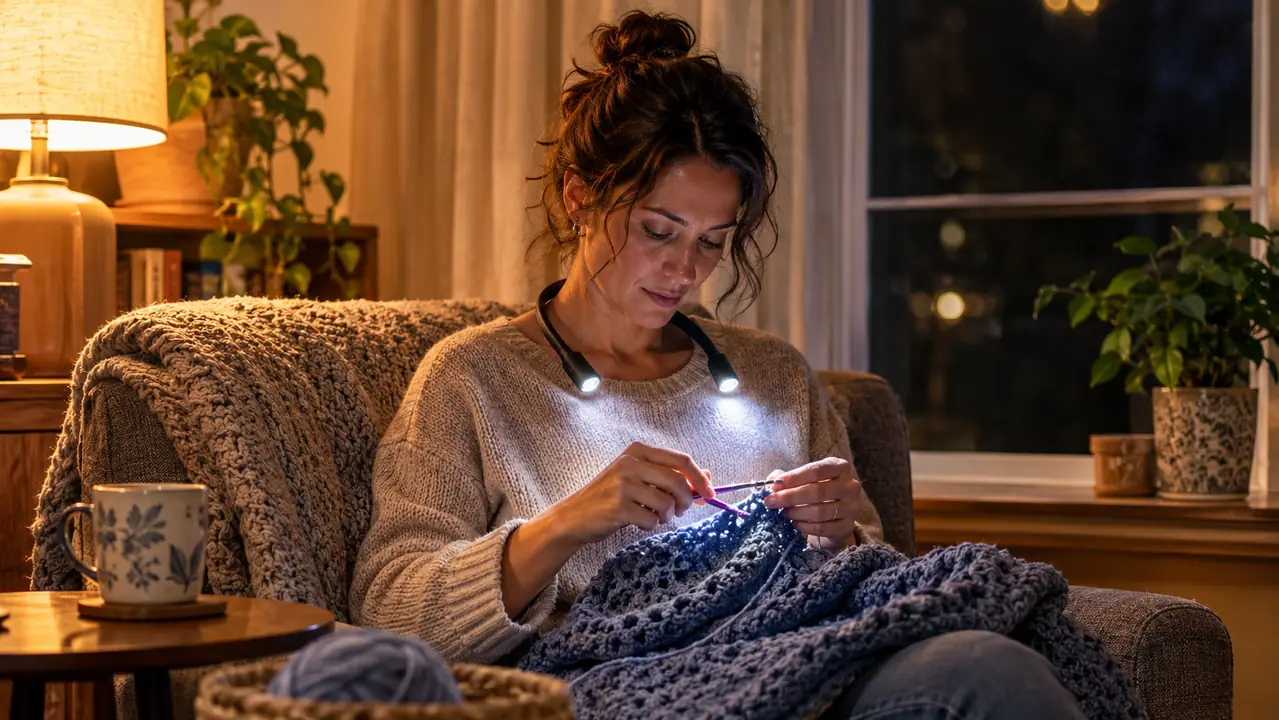
I bought the Glocusent neck light in October 2025 for a reason that has nothing to do with reading in bed. My floor lamp stands at my left shoulder, I crochet left-handed, and after dark my own hand throws a shadow directly across the stitch I am trying to get the hook into. Thirteen months later the light still lives on the arm of my chair, and I have a fair amount to say about what it does well and the two things that still irritate me.
The short version: it is sold as a reading light and I use it as a work light. Three color settings, three brightness levels, rechargeable by USB, and it rests around your neck so both hands stay free. I use the warm white setting on medium, evenings only, on top of the floor lamp rather than instead of it. That combination is what finally let me keep going past sunset in a Michigan November without stopping every few minutes to angle a lamp.
The Quick Verdict
A reading light that happened to solve a crocheter's shadow problem. It has earned its spot on my chair arm. The thirty-minute shutoff has not.
Amazon Check Today's Price →Your hand is the thing casting the shadow. Put the light on the same side of it you are.
Glocusent sells this for reading in bed. I wear it on warm white, medium brightness, over a floor lamp, and it is the only reason a navy row gets finished after dark in this house.
Amazon Check Today's Price on Amazon →How I've Used It
Thirteen months is long enough for a gadget to either earn a place on the chair arm or end up in the drawer with the stitch markers I never use. This one stayed. I crochet most evenings from about seven until nine or ten, in a small armchair by the front window. In summer there is still light in the sky at eight. In winter there is not, and that is the four-month stretch where a neck light stops being a novelty and starts being part of the setup.
My routine has not changed since about the second week. I sit down, switch on the floor lamp at my left, loop the neck light on, and press the button to warm white and then again to medium. It rides on my collarbones rather than my throat, which matters because I wear a collar from October onward. The two ends sit forward of my shoulders and throw light down and slightly in, which is exactly where a hook and a working row live.
I recharge it about once a week at the kitchen counter, with the cable that came in the box. In thirteen months I have never had it die in the middle of a row and I have never had to plan an evening around the charge. That is the honest shape of the battery story. It is not a battery I think about.
I also use it for the unglamorous parts of the hobby: counting a long starting chain, reading a printed pattern that is smaller than it has any right to be, and threading a needle for the final seaming on a hat. My husband Walt noticed it before I said a word about it and asked whether I was planning to do surgery. He is not wrong about how it looks.
What the Three Settings Actually Do for Crochet
There are three color temperatures and three brightness levels. That is nine combinations and I use maybe four of them. The amber setting, the warmest one at 1800K, is what I would pick to read a novel in bed without waking anybody. For crochet I find it a touch orange on dark yarn, and it flattens the difference between navy and black. That matters more than you would think when you are changing colors at the end of a row.
Warm white, the middle setting at 3200K, is what I actually use. It is close enough to the floor lamp that my eyes are not readjusting every time I look up, and it is bright enough to show the legs of a single crochet in a worsted weight yarn. On medium brightness I can work a full two-hour session without the light itself becoming the thing that tires me out.
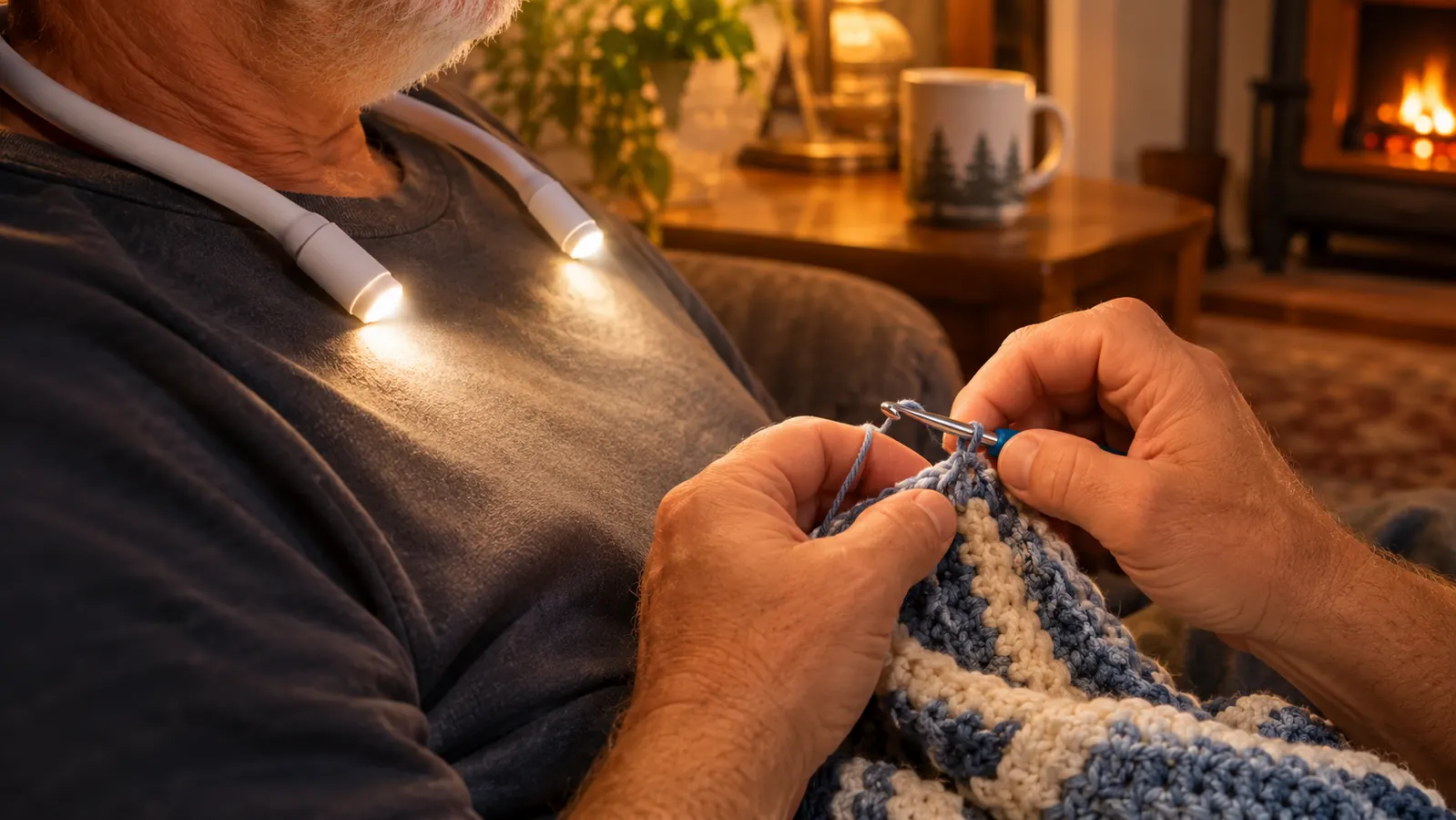
The cool white setting is brighter and bluer and I do not like it for long stretches. It is, however, the setting I reach for when I am ripping back four rows of a shawl and need to find one specific stitch. The narrow beam is the part worth understanding before you buy. It is a focused pool of light roughly the width of a dinner plate in front of you, not a wash of light across the room. Aimed at your work, that is a good thing. Aimed wrong, you will be nudging it with your shoulder every few rows.
Four light sources are what build that pool. The one nearest my working hand is the one I notice, because my left hand is the one in the way. That is the entire reason this works where a lamp does not. The lamp lights the room. This lights the stitch.
Where It Earns Its Place: Dark Yarn After Dark
I make baby blankets for my church's winter drive, dishcloths by the dozen, hats, and the occasional shawl. In winter the yarn is often dark, because that is what people ask for and because dark yarn hides the coffee. Dark yarn plus a shadow plus a sixty-four-year-old pair of eyes is a bad combination, and it was the combination I had for years.
The first project I finished with the neck light on was a navy baby blanket. The difference was not subtle. I could see the space between stitches, which meant I stopped pushing the hook in by feel and hoping. My rows got more even through the middle of the blanket, which is where I usually loosen up. I am not going to claim it improved my crochet. It removed a reason to stop.
It also changed how long I sit, though not for any reason to do with my hands. I used to quit when my eyes got tired of squinting at the same four inches of fabric. Now I quit when I am finished with a row. That is a small thing on paper and it is the reason the light never went in the drawer.
What Held Up Over Thirteen Months, and What Annoys Me
The build has held. The neck piece has not cracked, the button has not gone mushy, the charge port has not loosened, and at 126 grams it is light enough that I forget it is there until I stand up. The whole thing is a little under ten inches long and less than an inch thick at the neck, so it drops into the outside pocket of my project bag without an argument. Cordless and hands free are not marketing words on this one. They are the whole point.
Two small notes on what comes in the box. The included bookmark is an odd thing to put in a crocheter's hands and I have never used it once. The cable is short, which is fine at the kitchen counter and useless across the living room, so I charge it where the outlet is and carry it back.
Now the annoyance. The light shuts itself off after thirty minutes. I understand why a light sold for reading in bed does that and I understand that it protects the battery. I still find it irritating in the middle of a long row on a big blanket, because it always seems to land at the exact moment I am counting. I reach up, press the button twice, and get back to it. Maybe four seconds, two or three times an evening. Nobody should buy or skip this over four seconds, but nobody warned me either, so now you are warned.
The second annoyance is fit. I am five foot one and I sit in a chair built for somebody taller, so my feet do not rest flat and my posture is already a compromise before the light shows up. A neck light sits where it sits. Over a thick turtleneck the ends ride a little high and I nudge them down. If I lean back to stretch, it slides. It is not uncomfortable. It is just not invisible.
The third is that the narrow beam makes you chase it. When I turn my work to start a new row, I turn the light with my shoulders whether I meant to or not. After a few months that became automatic, so it is a learning curve rather than a flaw. Worth knowing in week one so you are not surprised in week two.
What I Liked
- Puts light exactly where the work is, so your own hand stops shadowing the stitch
- Warm white on medium is comfortable for a two-hour evening session
- Both hands stay free, which is the entire point for crochet
- About 126 grams and under ten inches, so it disappears into a bag pocket
- Battery has never once interrupted a row in thirteen months of weekly charging
- Symmetrical, so being left-handed costs you nothing
Where It Falls Short
- Shuts off after thirty minutes and has to be switched back on mid-row
- A narrow beam is wrong for blocking, laying out a blanket, or lighting a table
- Slides when you lean back, and rides high over a thick collar
- The included bookmark is dead weight for anyone who does not read in bed
- You will spend the first week aiming it with your shoulders
The difference was not subtle. I could see the space between stitches, which meant I stopped pushing the hook in by feel and hoping.
Left-Handed and Five Foot One: How It Fits
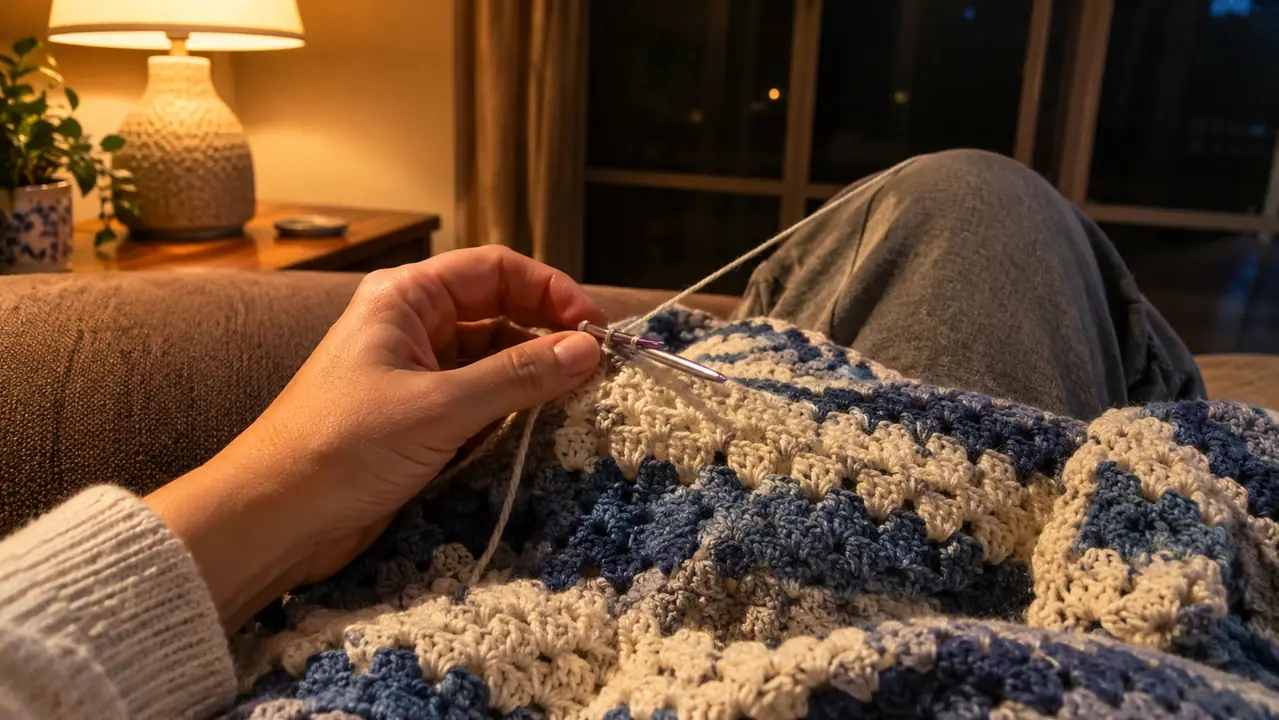
I taught myself to crochet at twenty-nine from a library book propped in front of a mirror, because nobody near me crocheted left-handed. Thirty-five years later I am still adapting tools designed with somebody else in mind. A neck light is one of the few things that does not care which hand holds the hook. Light is light. It has no dominant side, no left-handed version, and nothing to flip.
The short-person part is real, though. Most of my crochet problems are geometry problems. The lamp is too tall, the chair is too deep, the table is too high, and I have spent decades propping and stacking to fix it. A light that hangs on my own body sidesteps all of it. It is at the height of my work because I am at the height of my work, and it moves when I move.
If your hands stiffen after an hour the way mine do, this will not change that. What it changes is where you stop. I used to stop because I could not see. Now I stop because my left thumb says so, I put on the compression gloves, and I keep going a while longer. The light is honestly the reason the gloves get used at all.
Who This Is For
Buy it if you crochet or knit in the evening in a room where the light comes from one side. Buy it if you have ever tilted a floor lamp toward your lap and gotten a face full of glare for your trouble. Buy it if you work with dark yarn, fine yarn, or a paper pattern printed in type that is too small. Buy it if you share a room with somebody watching television who does not want a lamp blazing away at nine o'clock.
It is also a good fit if you carry a project with you, or if you sit somewhere a clamp lamp cannot go. And it is a good fit if you are left-handed and tired of checking whether a tool comes in a version for you, because this one does not need to. The Glocusent design is the same in either hand.
Who Should Skip It
Skip it if you already have good, even, overhead light where you sit. This is a supplement. I use mine on top of a floor lamp, never instead of one, and I would not want to work a whole evening by neck light alone in a dark room.
Skip it if anything touching your neck would bother you. It rests on the collarbones and it is light, but it is there, and you will know it is there. Skip it if you need a wide wash of light across a table for blocking or laying out pieces, because a narrow beam is simply the wrong tool for that job. And skip it if a thirty-minute shutoff would make you unreasonable, because it will happen, twice a night, for as long as you own it.
One more. If you were hoping this would let you crochet longer without your hands complaining, it will not. It removes the light problem. It does nothing at all about the hand problem, and the Glocusent listing never claims otherwise.
The lamp did not move. I just stopped depending on it.
Thirteen months on the chair arm and it still gets switched on every evening. Warm white, medium, resting on the collarbones, with the floor lamp still doing its half of the job.
Amazon See the Glocusent Neck Light on Amazon →