
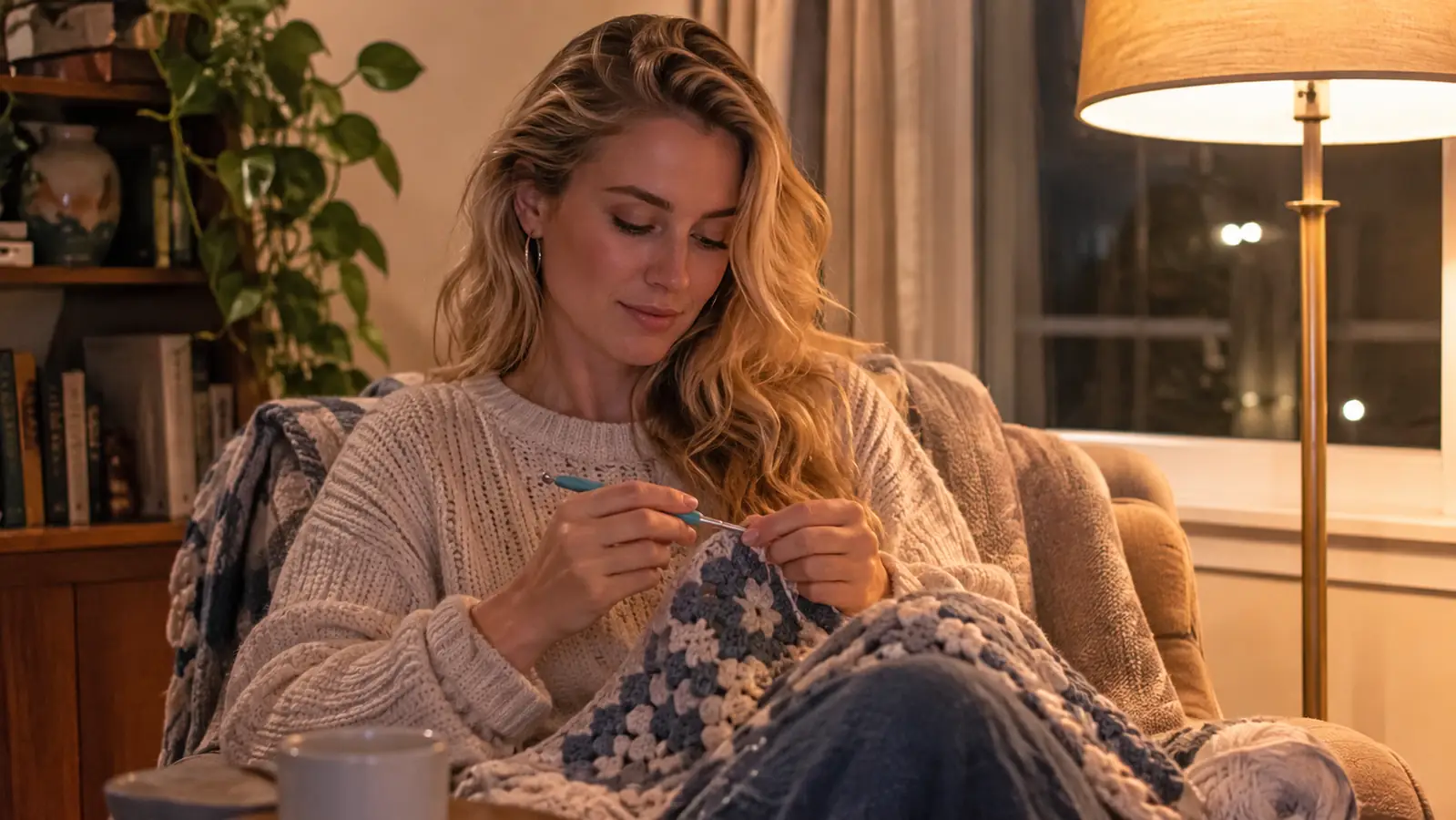
I crochet in a small armchair by the front window, and after dark the floor lamp at my left shoulder stops helping. My left hand holds the hook, so it sits between the lamp and the stitches, and the shadow lands exactly where I need to look. That is why I bought the Glocusent neck light in October 2025, and it is why I still reach for it on November evenings a year later, at 64, with a thumb that stiffens after about an hour.
But a neck light is not the only sensible answer to that shadow, and I do not think it is the right answer for everyone who crochets. So in October I spent four evenings working under an ordinary clip-on book lamp clamped to the arm of my chair, then four more under the Glocusent, same project, same hour of the night, same floor lamp standing by. The short answer: the Glocusent wins on where the light lands. A clip-on wins on staying off your body and on following a hoop around as you turn it. Which of those two matters more depends on how you hold your work, and there is no honest way for me to pick that for you.
How I Set This Up
Same chair, same project. First a half-finished dishcloth in a dark worsted, then a baby blanket in a pale DK, because I wanted to see how each light behaved on a color that swallows light and on one that throws it back at you. Same two hours, roughly seven to nine in the evening, with the floor lamp on for both. I never work by one light alone and I would not advise it.
The clip-on lamp is the common folding kind: a spring clamp, one flexible neck, a single LED, three AAA batteries. I am not naming a brand because they are all roughly the same animal, and mine came out of a drawer where it had sat since a visit from my daughter. I clamped it three ways over those four evenings, to the arm of the chair, to the small side table, and to a hoop. Two of those three worked.
| Glocusent Neck Light | Clip-On Book Lamp | |
|---|---|---|
| Where it sits | Around your neck, above your hands | Clamped to a chair arm, a table edge or a hoop |
| Shadow from the hook hand | The beam comes from above your work, so your hand is under it rather than in front of it | Light arrives from one side, and your hand can block it |
| Aiming as you work | Shift your head an inch and the light follows the row | Bend the flexible neck, then bend it again ten minutes later |
| Hoops and small motifs | The light stays where it was while the hoop turns | Clamp it to the hoop and the light travels with the work |
| Color and brightness | 3 color temperatures (1800K amber, 3200K warm white, cool white) and 3 brightness levels | Usually one setting, sometimes two, and no color choice on most models |
| Weight on you | 126 g around the neck, noticeable by the second hour | Nothing on your body at all |
| Keeping it running | Rechargeable by USB, cable included, and I plug it in about once a week | AAA batteries that fade slowly and then quit |
| Dark yarn and fine hooks | 90 degree narrow beam puts light on the stitches and keeps it out of your eyes | Wider spill, workable but more fiddling |
| Working away from home | Wear it, since there is nothing to clamp to | Needs a hard edge to grip, and soft chairs defeat it |
Where the Glocusent Neck Light Wins
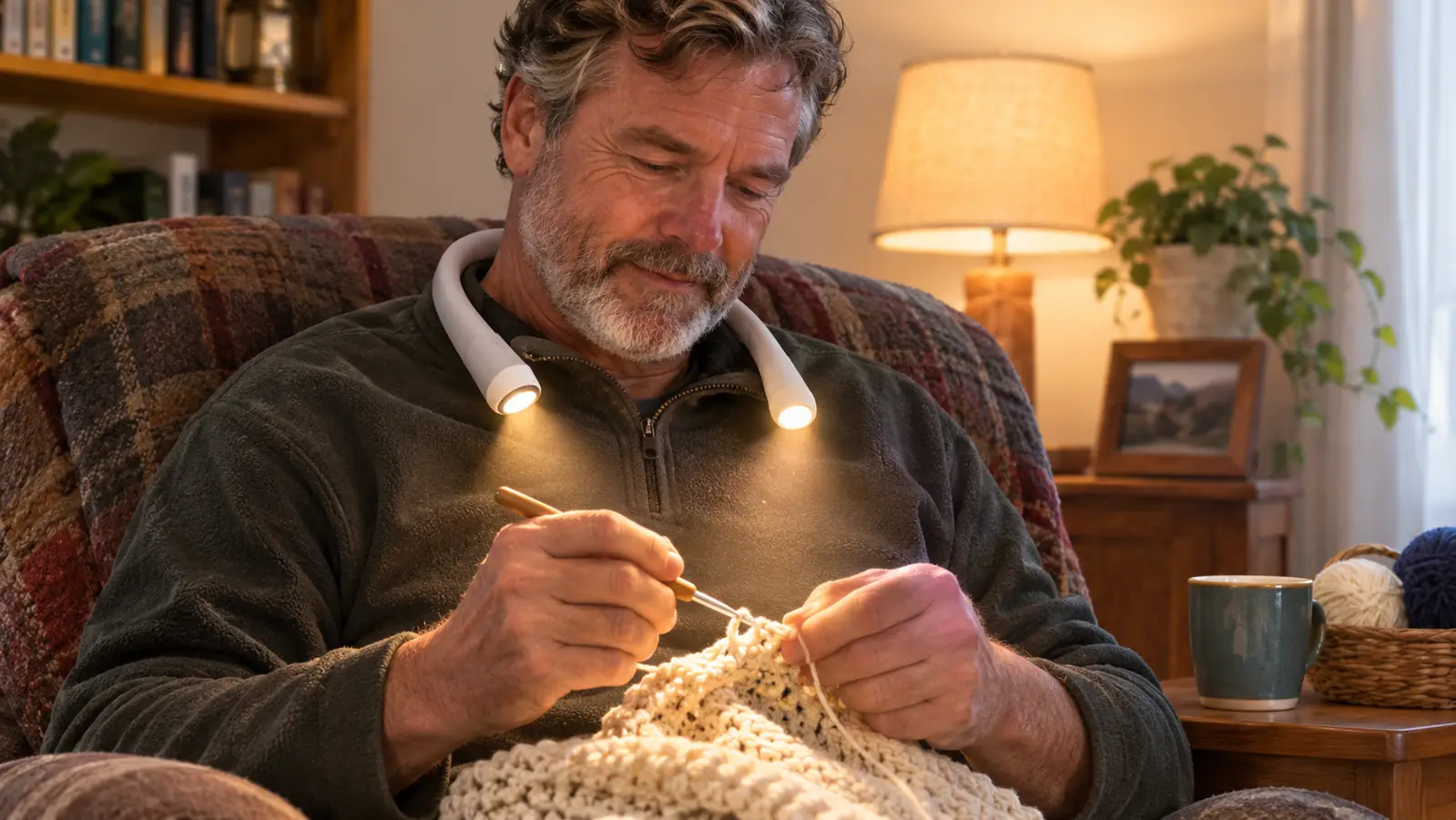
The reason I kept using it has nothing to do with how bright it is. It is geometry. The light sits around the back of your neck, above your hands, and the beam comes down onto the work from a point your own arm cannot get in front of. The listing describes a 90 degree narrow beam angle, which is a technical way of saying it lights a small patch and very little else. For crochet that is the correct behavior. I am not trying to light a room at nine at night. I am trying to light eleven stitches and one hook.
It offers three color temperatures, amber at 1800K, warm white at 3200K, and cool white, plus three brightness levels. I have used exactly one combination for a year: warm white on medium. Amber is restful but it pulls a dark green yarn toward brown, and when I am matching a color for a blanket square I want to see the color I actually bought. Cool white separates the legs of a stitch beautifully and feels like a classroom at night. Warm white on medium is what my eyes forgive at the end of a long day.
The narrow beam has a second effect I did not expect. Because it points where I look, I can shift my head an inch and the light moves with the row without my hands leaving the work. Under the clip-on I was reaching up every few minutes to bend the flexible neck back to where I needed it, and every one of those small interruptions costs a stitch count. Over two hours that adds up to a great deal of reaching, and reaching is what makes me put the hook down early.
It weighs 126 grams, a little under five ounces, which is light enough that I forget it for the first hour. By the second hour I know it is there, and I lift it off between rows when I stop to read a pattern. The neck area on this model is narrowed to sit closer than the older wide designs did, and I think that is why it stays put when I lean forward to count a long chain.
Charging is the one chore. The cable is in the box, I keep it at the kitchen counter, and I plug the light in about once a week whether it needs it or not. Twice in a year I forgot, and both times I finished the row under the floor lamp with my teeth gritted. That is not the lamp's fault, but it is the honest accounting.
Where the Clip-On Lamp Wins
If you work in a hoop, the clip-on has an advantage I will not argue with. You can clamp it to the hoop itself, and then the light travels with the work as you turn it. That is genuinely better than turning your head to chase a hoop that has rotated out of the beam. Most of what I make is flat, so this does not come up often, but I did a mandala in a hoop in October and for those four evenings the clip-on was simply the better tool.
Second, it puts nothing on your body. I am 5 foot 1 with a short neck, and anything around it announces itself by the second hour. The narrowed neck on the Glocusent helps, and it is the only neck light I have been able to wear for a whole evening, but close is still on. If you already know that a thing resting around your neck will bother you, that is a real reason to choose the lamp that clamps to the furniture instead.
Third, mine runs on three AAA batteries, and there is a certain peace in a lamp that never has to be charged. The batteries fade slowly and then quit without warning, which is its own annoyance, so I would call this particular row a draw rather than a win. It is the honest answer, and I would rather give you the honest answer than hand the lamp a prize it did not earn.
If your own hook hand is the thing casting the shadow, this is the light that gets above it
Three color temperatures, three brightness levels, and a 90 degree beam that stays on your stitches instead of the room. Warm white on medium is the setting I have not changed in a year.
Amazon See today's price on Amazon →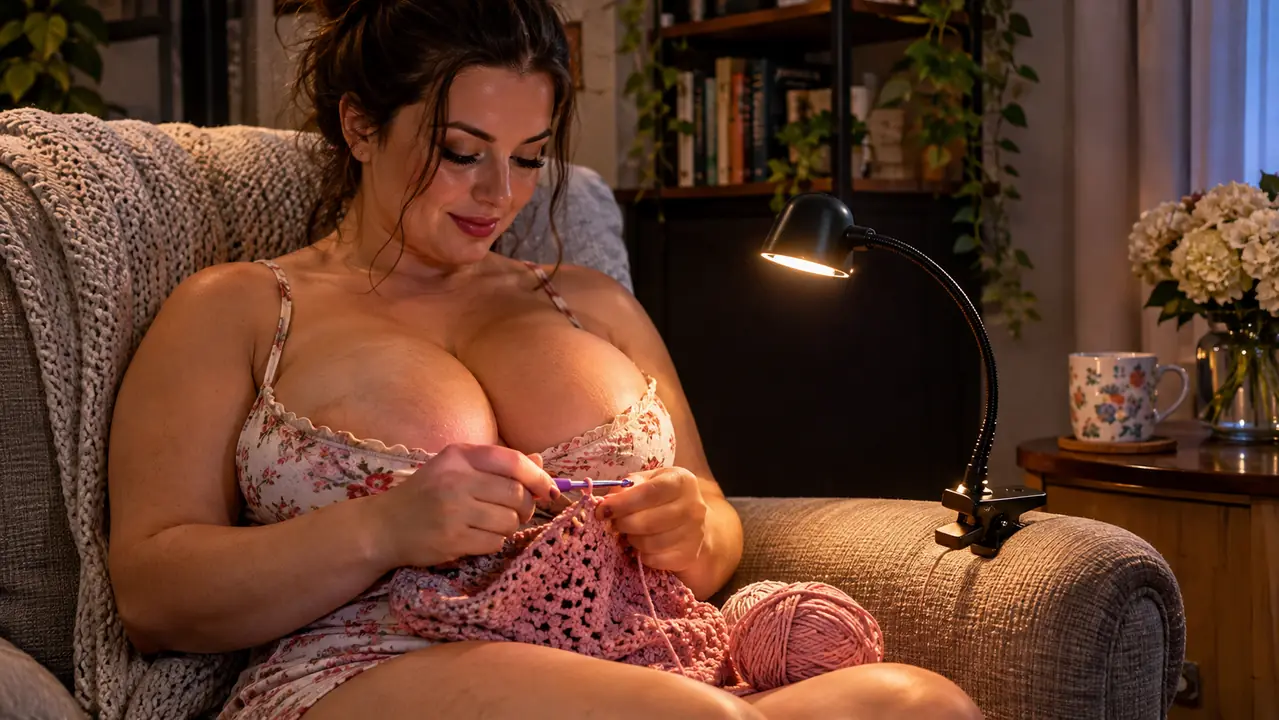
The Small Things That Decided It for Me
I am left-handed and I have crocheted for about 35 years, so my hook is in my left hand and I work right to left, mirrored. That means the hand blocking my light is the hand doing the fine work, which is the opposite of what most lighting advice assumes. A lamp at my left shoulder is behind the action. A light from directly above is not. If you are left-handed too and you have been blaming your eyes, move the light before you blame anything else.
On a 2.25 mm hook with a dark worsted, the difference between warm white on medium and the floor lamp alone is the difference between seeing the legs of a stitch and guessing at them. I noticed it most on a navy baby blanket last winter. Under the floor lamp I was counting by feel. Under the neck light I could see both legs of each stitch, and the corners came out with fewer fudges than usual.
The clamp is the other small thing. On my armchair the arm is padded and rounded and the clamp never felt secure, so I fixed it to the small side table instead, which put the light off to my left again, which is precisely where the problem started. A clamp needs a hard edge. A neck needs nothing at all.
I am not trying to light a room at nine at night. I am trying to light eleven stitches and one hook.
What Neither Light Fixes
Neither lamp does anything about the chair. I am 5 foot 1 and my feet do not sit flat on the floor in most armchairs, so I use a cushion behind me and a footstool under me. Without those, no light in the world keeps me comfortable past an hour. If you are short and you have been shopping for lighting to solve a comfort problem, spend an evening on the footstool question first, then come back.
Nor does either lamp do anything about the thumb. Mine stiffens at the base after about an hour of work, worse in cold weather, and that is a hook and grip question rather than a lighting question. I handle it with a different hook and a pair of gloves once the weather turns. Lighting is one piece of a comfortable evening. It is the piece that made the most visible difference for me, and I would not want you buying a lamp expecting it to fix everything else.
Who Should Buy Which
Buy the Glocusent if your lamp sits at your side, if your hook hand throws the shadow, if you work evenings in a chair you cannot easily move, or if you carry your crochet to a church hall or someone else's kitchen table. It is also the better pick if you work in short stretches, since the light goes on and off with a push of a button and there is nothing to set up and nothing to clamp. For a left-handed crocheter in a chair by a window, it fixed a problem I had quietly accepted for years.
Buy the clip-on lamp if you work almost entirely in a hoop, if you truly cannot tolerate anything around your neck, or if there is already one sitting in a drawer. For a hoop project and a chair with a good solid edge to clamp to, it does the job and I would not talk anyone out of it. What I would not do is buy one expecting it to fix a shadow cast by your own hand. It moves the light around the work. It does not get above the work, and above is where the fix lives.
If you are buying for someone else, the neck light is the safer gift, because it does not depend on the shape of their furniture or whether their chair has an edge worth clamping. And if you are new to all of this, the order I went in was a floor lamp first, the neck light second for after dark, everything else after that. Mostly by accident, and it held up.
Start on warm white, medium, the way I did
That is the setting I have not touched in a year of evenings. The amber and the cool white are there when a project calls for them, and the beam stays narrow either way.
Amazon Check the current price on Amazon →