
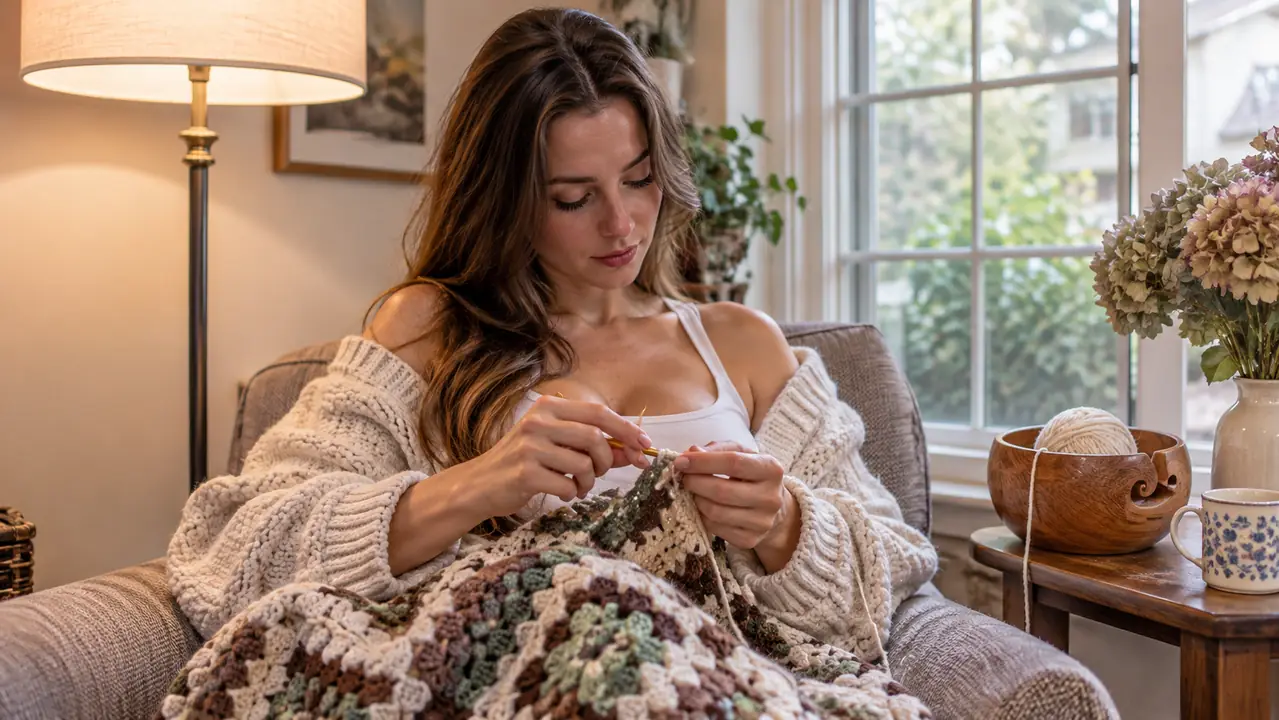
I crocheted for about 35 years before I admitted that my hands, not my yarn, were setting the length of my sessions. I would sit down at nine in the morning with a cup of coffee and a baby blanket on my lap, and by ten my left thumb was telling me to stop. So I stopped, and then I spent the rest of the day annoyed about it. The fix, when I finally got one, was not a single purchase. It was five small habits done in a certain order, and one of them was a pair of cotton Dritz Crafters Comfort gloves I bought in February 2026 and have worn most days since.
I tried the obvious things first. I bought a pair of fingerless compression gloves at a drugstore and wore them a month before giving up, because they squeezed hard across the palm and made my hand feel worse rather than better. I tried holding the hook looser, which mostly meant dropping stitches. I tried the standard advice to take breaks, which is fine as far as it goes, except nobody tells you when. A break you take after the ache starts is not the same as a break you take before it, and that difference is what this whole routine is built around.
The gloves go on before the ache, not after it
Cotton, lightweight, medium stretch, pull on, hand wash only. I have the Medium, and I wear them for any session over about an hour and any cold afternoon.
Amazon Check Today's Price on Amazon →Step 1: Set the chair and the light before you sit down
This sounds like fussing, and for years I skipped it. But the position you start in is the position you stay in for an hour, so it earns its two minutes. I am 5 foot 1, and my feet do not reach the floor flat in most armchairs, which meant I used to crochet with my legs tucked under me and my lower back doing the work. Now there is a firm cushion under my feet, both of them flat, and I sit back against the chair instead of perching on the front edge like a bird.
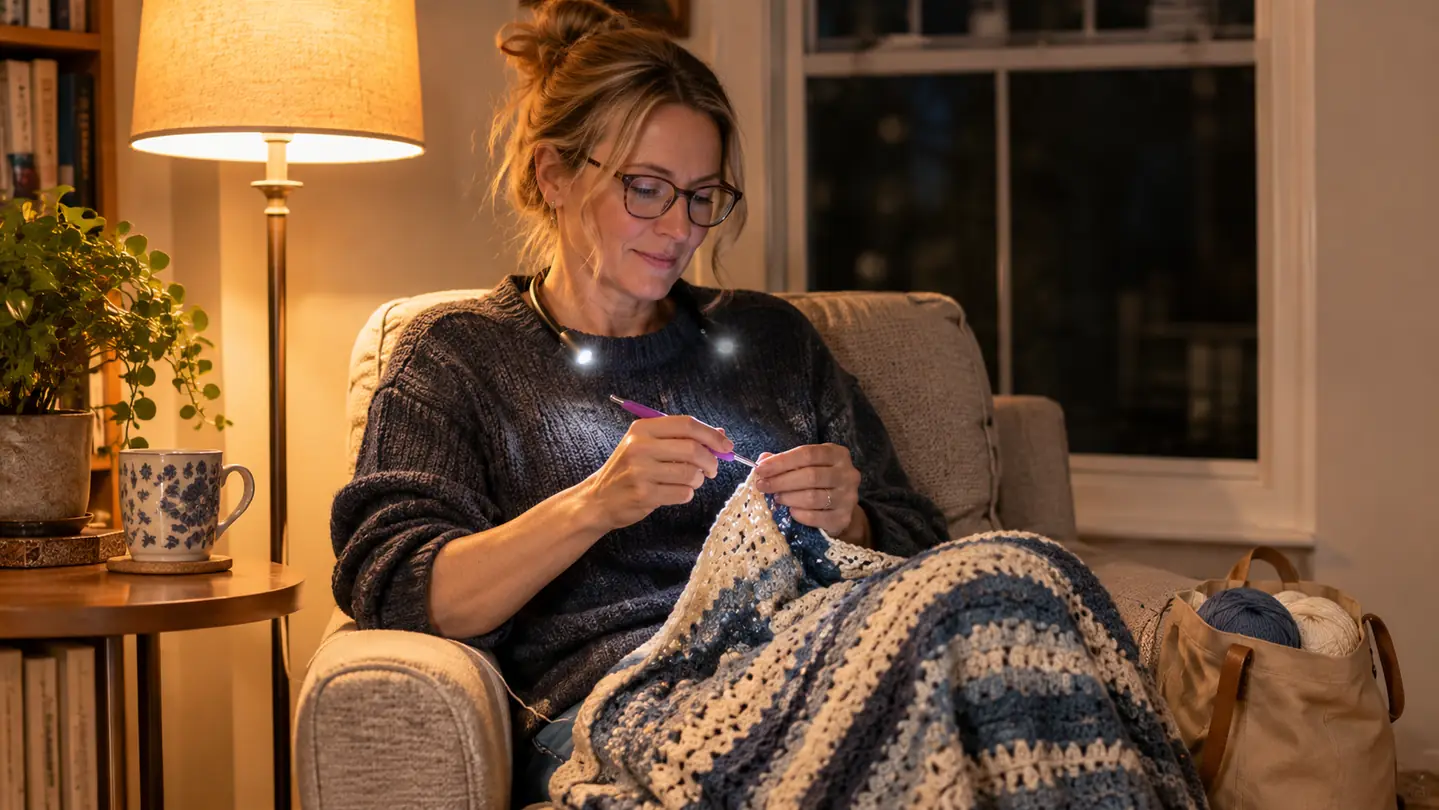
The light matters more than people expect, especially for a left-hander. My floor lamp stands at my left, so my own left hand throws a shadow straight across the stitch I am trying to see. I lived with that for decades and assumed it was normal. Now I wear a Glocusent neck light on the warm white setting at medium, evenings after dark only, in addition to the floor lamp and never instead of it.
Two honest notes on the light, since I promised to mention the annoying parts. It turns itself off after 30 minutes, which is genuinely irritating in the middle of a long row, and I recharge it about once a week at the kitchen counter. It is sold as a reading light. I simply use it for crochet. My husband Walt noticed it before I did and has not stopped teasing me about the glowing necklace.
Step 2: Put the gloves on before your hand starts talking
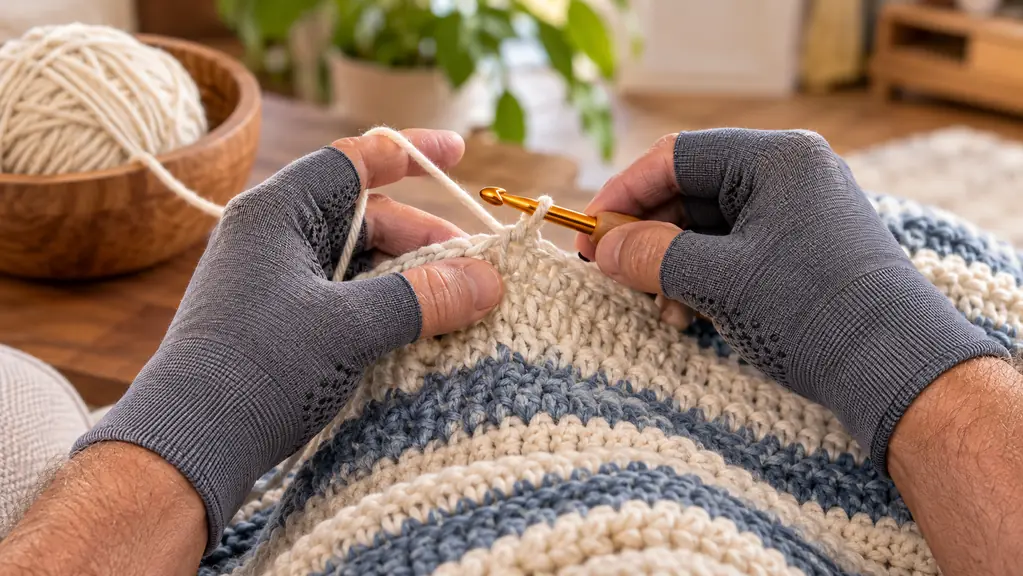
I used to think gloves were for people with worse hands than mine. Then I noticed I was rubbing the base of my left thumb between rows and losing my place in the pattern. The Dritz gloves came home in February 2026 and I have owned them about nine months. They are cotton, lightweight, medium stretch, pull on, hand wash only, and mine are Medium, which is a little roomy on my small hands. I would rather tell you that than pretend they fit like they were cut for me.
What sold me was the timing of them. I felt warmer straight away, which matters in Michigan from November through April. The part I did not expect came around the second week, when I noticed I was finishing a session less stiff than I used to. Not fixed. Not cured. Just less stiff at the end, which is comfort, and comfort is the only thing I am claiming here. I wear both gloves for any session over about an hour and in cold weather, and I hand wash them every couple of weeks.
The fingers are free at the tips, and that is the reason I actually keep them on instead of peeling them off after ten minutes. I can feel the yarn and count stitches without fighting a seam. A glove that covers your fingertips will have you taking it off all evening. Mine stay on.
One sizing note. If you are between sizes, remember that a glove which pinches across the palm the moment you pull it on will not loosen into something better by the end of the row. Mine are roomy and it has not bothered my work at all. The drugstore pair that squeezed went into the donation box after a month.
Step 3: Work in stretches you can count
Forget the advice to take breaks. Take a stretch that has a number on it. I work about 25 minutes and then put the work down for five, and the five only counts if I actually stand up. Getting another coffee and sitting straight back down is not a break, it is a cup. When I am working on a blanket for the church winter drive, I set a kitchen timer, because your row count lies to you when you are enjoying yourself.
Here is a small accident that turned out useful. The neck light clicks off by itself after 30 minutes, and I have started treating that as the second half of the timer. When the light goes dark I finish the stitch I am on, stand up properly, and walk to the window. In winter I use all five of my things together on those evenings. It is the closest I get to an assembly line, and it is the only reason those blankets get finished.
In cold weather, warm your hands before you start, not after they complain. I run warm water over mine for a minute while the coffee brews. It sounds like nothing. It changes how the first ten minutes feel, and the first ten minutes usually decide whether I sit down at all.
Step 4: Change how the yarn feeds so your grip hand gets a rest
The hand that aches is not always the one doing the work. My left hand holds the hook because I crochet left-handed, and my right hand manages the tension, and for years that right hand clamped the working yarn like it owed me money. A tight grip on the yarn means a tight grip on the hook. It took me a long time to see the two were connected.
The wooden yarn bowl fixed more of that than I expected. It sits on the small side table to my right, about 6 inches across and 3 inches tall, 13 ounces, and it holds one standard 3.5 ounce ball. A jumbo skein will not fit, so I wind those down first. The yarn feeds across to my left hand instead of me dragging a ball around the chair. The first evening it stopped the ball rolling under the furniture, which was worth the trouble by itself. It stays home. It does not travel.
Now I check my tension every few rows the way I check my stitch count. If the yarn is biting into my fingers, I loosen it on purpose. It feels wrong for about a minute and then it feels normal. If you are right-handed, mirror everything I have said. Bowl on the other side, light on the other side, other hand doing the gripping.
Step 5: End the session on purpose
Most of us stop in the middle of a row because dinner is ready, and then the next session starts with a puzzle. I have started ending on a plain row of single crochet, something I could do half asleep, and writing the hook size and the row number on an index card that goes into the project bag. Ten seconds of work that saves me fifteen minutes of squinting the next morning.
The bag, a large canvas CRAFTISS with a zipper, a removable divider and an included zippered case, keeps the whole thing together. Current project inside, hooks in the zippered case, gloves in one of the three outside pockets. At 5 foot 1 I carry it by the top handle rather than the shoulder strap, because the strap hangs the bag down around my knees. It lives on the floor beside my chair and rides in the car when Walt and I drive the two hours to see our daughter Beth.
Then the last thing, which takes a minute: I wash the Dritz gloves. Hand wash only, lukewarm, laid flat to dry on the kitchen table. If you let them sit in the bottom of a bag for a month they get that stiff feeling back, and you will decide the gloves do not work when in fact you never washed them.
What Else Helps
Hooks. If you are still working with plain aluminum hooks, the handle is doing nothing for you. I used Susan Bates Silvalume hooks for about 30 years before I bought a set of 10 Clover Amour hooks in September 2025, B through J, each size with its own soft grip handle on aluminum. Within about two weeks I could go roughly 20 minutes longer before stopping to rest my thumb. The grip is symmetrical, so left-handers need nothing special. The honest downside is that it is a real price for hooks, and those handles are bulky in a small pouch.
A bowl that stays put and a light that follows your hands will do more for a long evening than another hook size. And a bag that keeps the whole kit in one place is the difference between sitting down to work and spending ten minutes hunting for the hook you need. None of these is a treatment for anything. They are comfort and convenience, and I say it that way on purpose, because a bad purchase is still a bad purchase even when somebody online raved about it.
If you are going to start somewhere, start with the Dritz gloves and the timer. Neither asks much of you and both work from the first evening. The neck light comes next if you work after dark, then the bowl if your yarn keeps escaping, then the hooks if you have been meaning to replace them anyway. Buy one thing at a time and use it for a month before you buy the next.
A break you take after the ache starts is not the same as a break you take before it.
The simplest change, and the one I would make first
Cotton, lightweight, medium stretch, pull on, hand wash only, sold as a size Medium pair. Put them on before you sit down, wash them every couple of weeks, and see how the end of the evening feels.
Amazon Check Today's Price on Amazon →