
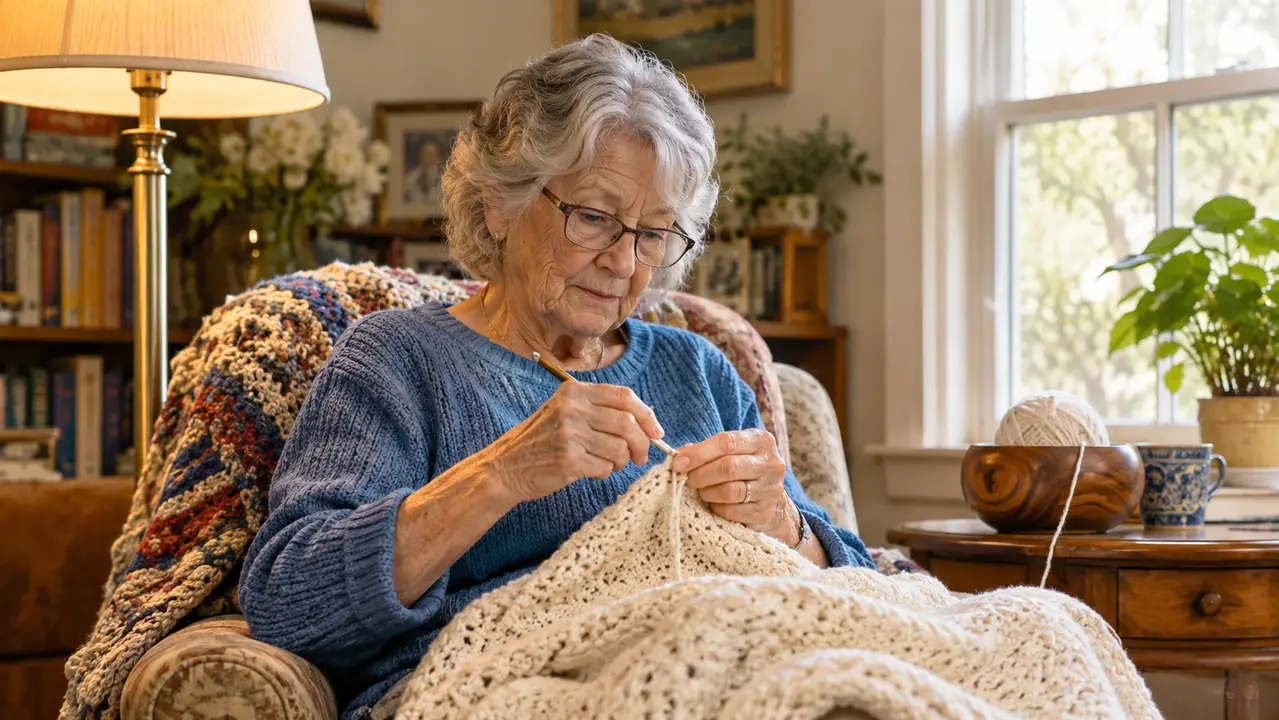
I bought the Clover Amour set in September of 2025, and I want to start with the part most crochet hook reviews leave out. I did not need them. I had worked for roughly thirty years on plain aluminum hooks with no handle at all, and those hooks made every blanket, dishcloth and hat I own. Nothing was broken. Nobody was suffering. So this is not a story about being rescued by a purchase. It is a story about spending real money on ten hooks I was not sure about, using them every week for fourteen months, and having a fairly firm opinion now about what they do and what they do not.
I am left-handed, five foot one, and sixty-four, and all three of those facts change what a hook has to do for me. My left hand holds the hook and works right to left in mirror image, which means a handle carved for a right hand is a small daily annoyance I have lived with since 1990. My hands are small, so a fat grip is not automatically a kindness. And the base of my left thumb gets stiff after about an hour of work, worse once the cold sets in. If any of that sounds like your own situation, this review was written for you. If you want the shorter version, the verdict is directly below. If you want the parts that made me put the hook down and think, keep reading.
The Quick Verdict
Comfortable enough that I stopped thinking about my thumb, sold as a loose set of ten with no case, and priced like a real purchase. Fourteen months in, I would buy them again.
Amazon Check Today's Price →If your thumb quits before your row does, start here
The set I have used every week since September 2025. Ten hooks, soft grip on polished aluminum, B through J. No case in the box, so have somewhere to put them before they arrive.
Amazon Check Today's Price on Amazon →What Nobody Tells You Before You Buy
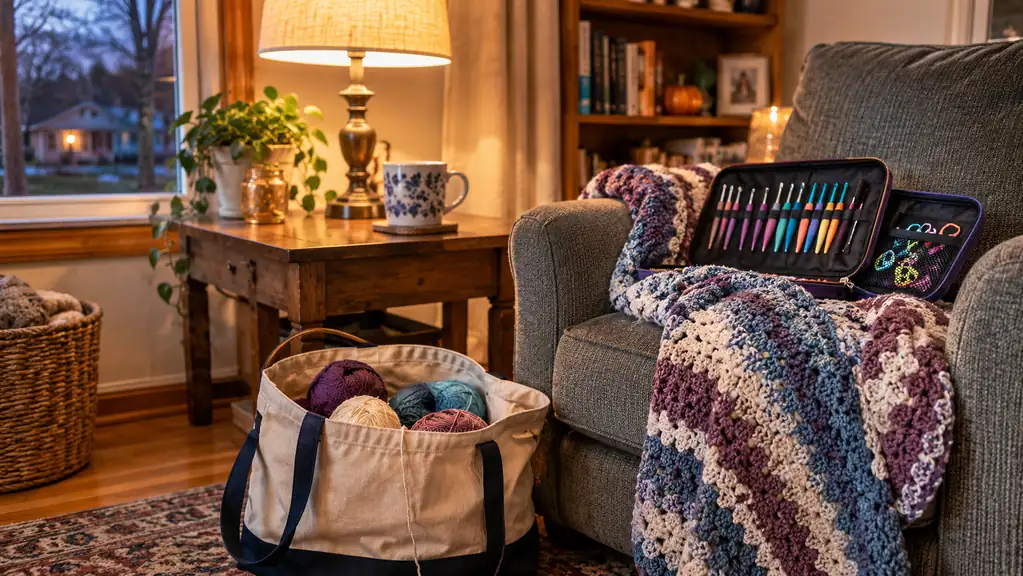
First, there is no case. You get the ten hooks and that is the whole of it. The set arrives loose, and loose hooks go to the bottom of a bag and stay there. Mine live in the zippered case that came inside my canvas project bag, and if I had not already owned that bag I would have spent the first week hunting for a pencil case. This is not a scandal. It is simply a thing you will be solving on day one, and it would be nice if the listing said so.
Second, the price is a real price. This is not a beginner's first purchase and I would not tell a new crocheter to start here. Buy one hook in the size your pattern calls for, learn on it, and come back to a set when you know what you like and which sizes you actually reach for. The only reason I bought ten at once is that I had thirty years of knowing exactly what I like.
Third, the handles are bulky. They are comfortable in the hand and they are not sleek. In a large canvas bag this is nothing at all. In the small pouch I used to carry to church on Sunday, they take up nearly twice the room of my old plain hooks, and that pouch no longer zips closed. If you work out of a little bag balanced on your lap, measure it before you order.
Fourth, and this one affects how you spend, the ten sizes run from B up to J. If you crochet worsted weight blankets and dishcloths the way I do, you will live in the G and the H and the J, and the rest will sit in the case looking at you. That is not a fault in the set. It is the honest shape of it, and it should factor into whether a set is right for you or whether two or three single hooks would serve you better for less.
Fifth, and this surprised me, the listing says warm to the touch. In a Michigan January nothing is warm to the touch, and I am not going to pretend otherwise. What is true is that the handle does not give you that cold shock a bare aluminum hook gives at seven in the morning in a house where the thermostat has not caught up yet. That is a smaller claim than the package makes, and it is the true one.
How I've Used Them, in Plain Detail
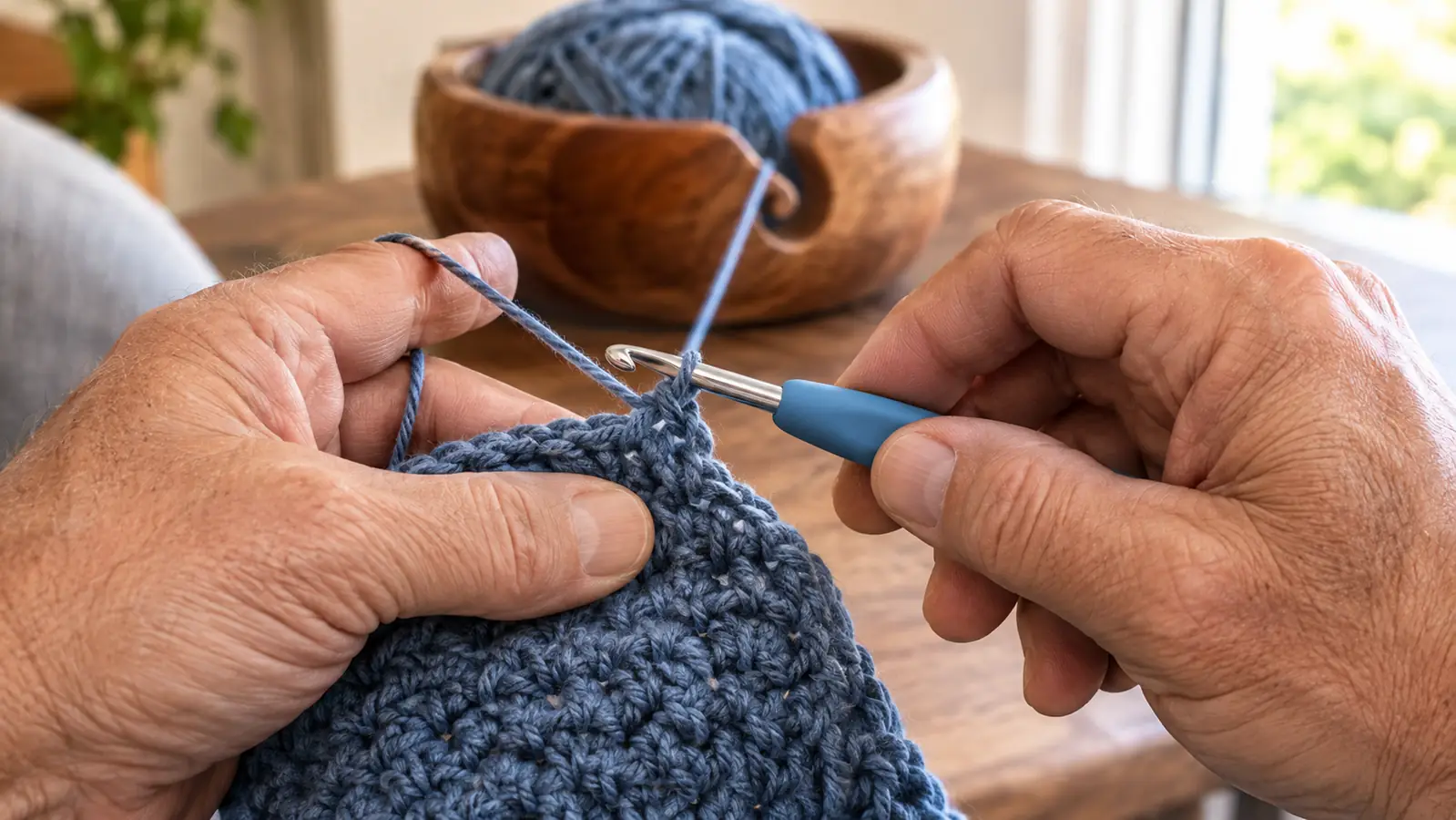
Fourteen months now. In that time I have finished three baby blankets for our church's winter drive, somewhere north of twenty dishcloths, four hats, and a shawl for my daughter Beth that took most of last winter and half my patience. Every stitch of that was worked with the Clover hooks. I keep the G and the H out on the side table and the rest in the case, and I have not touched my old aluminum hooks since about October of last year, though I still keep them in the drawer.
The thing I noticed first was time. Within about two weeks I realized I was going roughly twenty minutes longer before I stopped to rest my thumb. Not twice as long. Twenty minutes. I want to be careful here, because I cannot prove the hooks caused it. Maybe I was simply paying attention to my hands for the first time in years, on account of having spent money on them. But the twenty minutes held, month after month, in warm weather and in cold, and it is the single reason I have not gone back to the drawer.
The aluminum part of the hook is polished and smooth, and the yarn slides along it without the faint rasp you get from a hook that has seen a decade of work. There was no break-in period. It felt the same on the first evening as it feels now, which is more than I can say for the cheaper padded hook I bought at a craft fair years ago.
I should also say what the hooks had nothing to do with. My evening sessions only got comfortable once I sorted out the light and the chair, and neither of those came in the box. That is a separate conversation and I do not want to give a hook credit that belongs to a lamp.
The Left-Handed Question, Answered
People ask me whether a left-handed crocheter needs a special hook. For this set, the answer is no, and the reason is simple. The handle is symmetrical. There is no thumb rest carved into one side and no slant built for a right hand, so there is nothing to fight. I picked it up and used it the way I use everything, right to left in mirror image, and not once in fourteen months has it felt turned around.
That is not a small thing in my history. When I taught myself at twenty-nine, nobody near me crocheted left-handed, so I learned by propping a library book open in front of a mirror and reversing everything in my head. Half the tools I met in those years assumed a right hand. A hook whose handle does not care which hand holds it is a quiet mercy, and I wish the listing said so plainly instead of leaving it to reviewers to work out.
What left-handers actually struggle with is not the hook, it is the pattern. Charts read backwards for us. Written directions have to be translated on the fly. A designer who says to work the shell into the next space assumes your next is on the other side of the row from mine. No hook fixes that. I bring it up because a few reviews I read before buying implied the grip was designed for comfort in either hand, and it is, but a comfortable hand is not a rewritten pattern.
Where the Handle Actually Helps, and Where It Does Not
The grip is soft and warm to the touch and it has stayed that way. Fourteen months of steady use and the handles have not gone shiny, cracked or sticky. That last one matters. The padded hook I owned before went tacky at the thumb spot within a season and felt unpleasant all summer, and I half expected the same here.
It does not fix your setup, though, and I want to be blunt about that. I work in a small armchair by the front window, and at five foot one my feet do not reach the floor flat in it, so there is a footstool under the chair. When I forget to pull it out, my back complains within twenty minutes and no hook on earth prevents that. Same story with the lamp. My floor lamp stands at my left, which means my own left hand throws a shadow across the stitches, and that is a lighting problem, not a hook problem.
Where the handle does earn its keep is the long middle of a session, the part after forty minutes when I used to start bargaining with myself about finishing the row. That bargaining has mostly stopped. I would not call the change dramatic. I would call it twenty minutes, and twenty minutes is the difference between finishing the row and leaving it for morning.
The hook did not fix my hands. It bought me about twenty minutes a session, and twenty minutes is not nothing when you are sixty-four and halfway through a blanket.
The Things That Annoy Me
Nothing holds the set together. The hooks are loose, they roll, and on the kitchen table while I am sorting for a project they separate and drift apart. I put a rubber band around the case when we drive to Beth's, two hours each way, because otherwise the small sizes slide out of their slots and end up under the seat. Small complaint. Real complaint.
The bulk in a small pouch is the bigger one, and I am repeating it because it surprised me how much it mattered on Sunday mornings. And I will be honest about the sizes again. I paid for ten hooks and I use three of them with any regularity. The B and the C are for thread and fine cotton, which I do roughly never. That is a me problem and not a Clover problem, but a person deciding whether to buy the set deserves to hear it from someone who already did.
One more, and this is for the small-handed among us. If your hands are genuinely small, the handle will feel like a lot of handle. Mine are small and the first week I noticed it every time I picked one up. By the second week I did not, because the grip gives slightly under the fingers. But that first week, I noticed. If you are someone who cannot stand a fat pen, try one hook before you commit to ten.
What I Liked
- The grip stays soft and warm after fourteen months of steady use
- Polished aluminum hook, smooth from the first evening, no break-in
- Symmetrical handle, so left-handers need nothing special
- Set covers B through J and the sizes are easy to tell apart at a glance
- Bought me roughly twenty extra minutes before my thumb needed a rest
- Handles wipe clean and have not cracked, gone shiny or gone tacky
Where It Falls Short
- No case included, so the ten loose hooks need a home on day one
- Bulky in a small project pouch that used to zip
- A real purchase, not a beginner's first buy
- Three of the ten sizes rarely come out of the case for blanket work
- Nothing holds the set together, they roll and separate when loose
What Fourteen Months Actually Changes
A short review tells you how a hook feels on day three. Fourteen months tells you whether it stays that way, and that is the part I can speak to now. The handles have held their surface. The polished section of each hook has not dulled or picked up a burr, and I have dropped the H on a hardwood floor more times than I will admit. The set looks used, because it is used, but nothing has failed.
What changed is not the hook, it is me. I have stopped thinking about the tool entirely, which is the highest thing I can say about a piece of equipment. When I sit down after supper, I reach for the G or the H without looking and I get on with the row. My old aluminum hooks required a small mental adjustment every session, mostly about how long I had before my hand would need a break. That adjustment is gone.
What has not changed is the arithmetic of the set. Ten hooks, three that get used, seven that wait. I still think that is worth knowing before you buy. It did not stop me and it would not stop me again, but it is the sort of thing I would tell a friend across the table rather than let her find out on her own.
Who This Is For
This is for the person who crochets most days, an hour at a stretch or more, and who has started to notice her hands before she notices the pattern. It is for anyone left-handed who is tired of adapting every tool that comes into the house. It is for someone who already knows which two or three sizes she lives in and wants those sizes to be a pleasure rather than a chore.
It is also for the person who has tried a padded hook and been disappointed by how quickly the padding went tacky or flattened. This one has not done either. I cannot promise yours will behave the same, but mine has and I am not gentle with it.
Who Should Skip It
Skip the set if you are new to crochet. Buy one Clover in the size your first pattern calls for and see how the handle suits you before you spend on ten. Skip it if you crochet almost entirely in one weight of yarn, because you would be paying for seven hooks that never leave the case. Skip it if you need a case in the box, or if you work out of a small pouch on your lap, or if a fat handle in the hand drives you quietly around the bend.
And skip it if you have no complaint with what you already own. I bought these for a specific reason, twenty minutes a session, and I got it. If your plain aluminum hooks are doing everything you ask and your hands are not asking for anything, you already have your answer and it costs nothing.
Twenty extra minutes a session, if your hands are the thing that stops you
Ten hooks, B through J, soft grip on polished aluminum, four and a half stars from more than eight thousand buyers. Loose in the box, so find them a case first.
Amazon See Today's Price on Amazon →