
I bought the CRAFTISS crochet bag in May of this year, so it has been in my house about six months, and I want to start with the part the glowing reviews leave out. It is a good bag. It is also a big bag, bigger than you probably picture when you read the words large canvas organizer on a product page. I am 64, five foot one, left-handed, and I have been crocheting about 35 years, most of that with a plain canvas tote that my hooks fell to the bottom of. So I am not new to this. I know what I want a project bag to do, and I know what starts to annoy me about one after a month.
Here is the short version before the long one. The CRAFTISS bag is canvas, 10.23 by 10.23 by 12.2 inches, 1.4 pounds empty, with a zipper across the top, a divider you can lift out, three deep slip pockets on the outside, and a small zippered case that comes with it. Mine holds a baby blanket in progress, my hooks, and my gloves. What nobody tells you is that a bag this size stops being luggage and starts being furniture, and that the divider is the best thing about it right up until the afternoon it is in your way. Both of those are true, and neither one shows up in a product photo.
The Quick Verdict
A well-made canvas organizer that finally gives loose hooks a home. Buy it if your project lives in one spot and you carry it by the handle. Skip it if you wanted something you could fold into a purse.
Amazon Check Today's Price →Six months of daily use and the zipper has not caught once
The parts that fail first on cheap project bags are the ones this one covers for five years, and you have to register it to get that. Read the current listing and today's price on Amazon.
Amazon Check Today's Price on Amazon →What Nobody Tells You Before You Buy
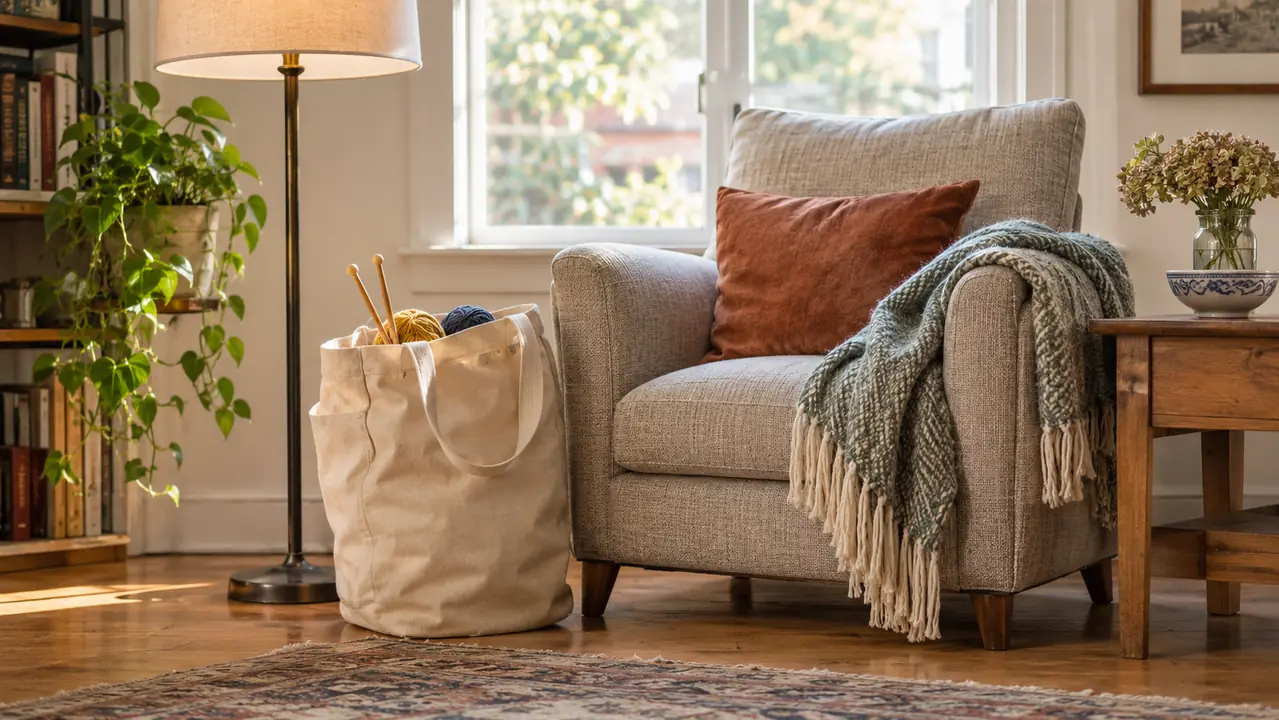
The first thing is the size, and it is the thing I would most want spelled out. The listing gives 10.23 by 10.23 by 12.2 inches, and 12.2 is the number that matters, because that is how tall it stands. On the floor beside my armchair it comes up nearly to the seat cushion. That is exactly what I wanted, since I keep an entire project in it and I like being able to zip the whole thing shut when the doorbell rings. If you pictured something you could tuck under an arm and forget about, this is not that, and no amount of reading reviews will shrink it. It holds 1000 cubic inches, which sounds like a small number until you watch a half-finished blanket disappear into it and still leave room on top for a pattern and a case. I measured it against the chair the week it arrived, because I am the sort of person who measures things. Standing on the floor it sits just under the cushion line, so I can reach into it from a seated position without getting up, which matters more at 64 than it would have at 40. What I did not expect was how much floor it takes. Six months in I have stopped noticing, but that first week I kept nudging it with my foot by accident.
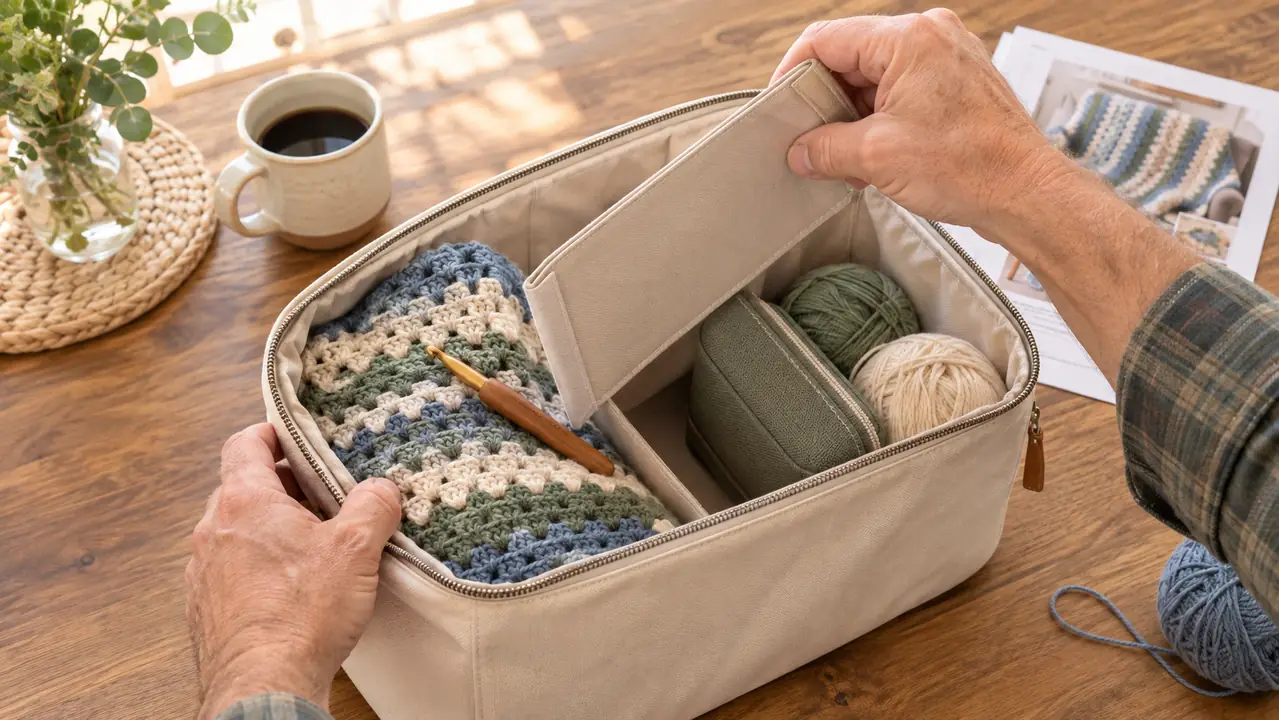
The second thing is the divider, and most descriptions mention it in passing, which undersells what it does. The bag is really two bags depending on whether that divider is in. Divider in, you get separate bays and nothing tangles, which is how I pack it for the car. Divider out, you get one open space deep enough for a larger skein or for a blanket that has gotten away from you, which is how I work at home. I move mine maybe once a month. I have never once wished it were sewn in, and I have never once had it slide out on its own when I did not want it to. One caution from experience: lift it straight up and set it down somewhere flat. The first time I pulled mine out at an angle, a half-finished row of a dishcloth came with it and I spent ten minutes getting stitches back on the hook. That was my doing, not the bag's, but it is the sort of thing that happens on a Tuesday evening when you are tired.
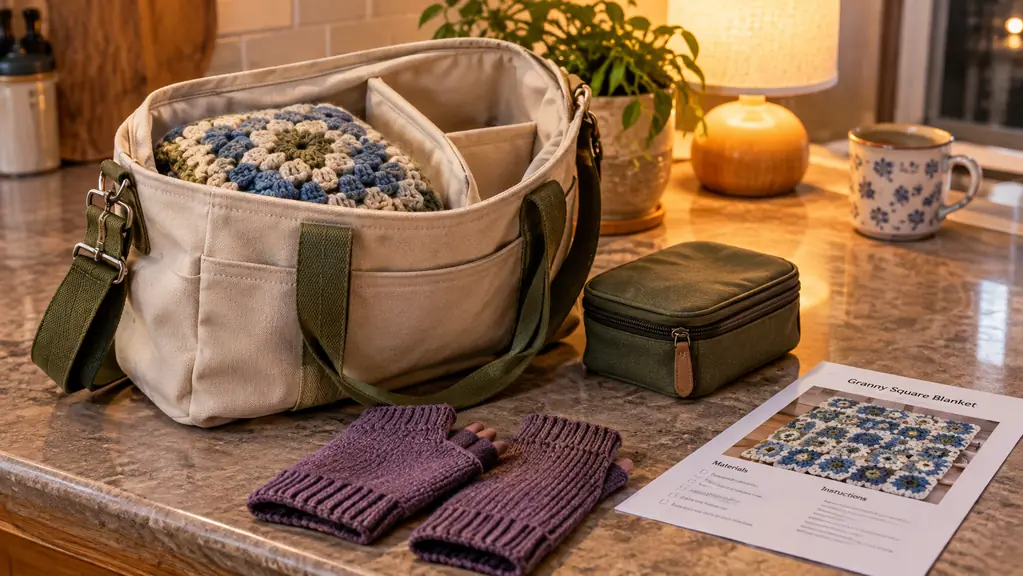
The third thing is the pockets, because the listing calls them deep and it does not call them closed. Three slip pockets on the outside, open at the top, plus the small zippered case that comes inside. Slip pockets are quick to use and I like them for that. They are also open at the top, and if the bag tips over in the car, whatever is in one is coming out. My gloves live in an outside pocket and I have picked them up off a car floor mat twice now. What I do these days is keep the gloves in the pocket that faces the chair, so the bag never rests against the wall and never leans that way. Small thing. It ended the twice-a-month glove rescue.
The fourth thing is the warranty, and this is the one nobody mentions in a review. Zippers, stitching and hardware are covered for five years on this bag, but only if you register it. I filled out the registration on the kitchen table in June and put the confirmation email in the zippered case where I could find it again. The form asks for your order number, so pull that up before you sit down. Do it in your first week. A five-year warranty you never activated is just a sentence printed on a box.
How I've Used It for Six Months
My hooks used to live loose in a tote, which meant every session began with me fishing around the bottom of a bag for a 4.00mm. I have a set of ten Clover Amour hooks that came with no case of their own, each size on its own handle, and the included zippered case from this bag is where they live now. That single change did more for my evenings than anything else I have bought for this hobby in years. I open the case, I take out the G or the H, I zip it back up, and I put it away. I have not lost a hook since May.
The main compartment holds whatever blanket or shawl I am on, plus the printed pattern when I have one. My Dritz gloves go in an outside pocket so they are the first thing I touch when my hands are cold. The bag sits on the floor beside my armchair and the wooden yarn bowl sits on the small table to my right, and the two do different jobs without stepping on each other. The bowl feeds yarn at home. The bag carries and stores. I only use the top yarn slots when I am away from home, because at home the bowl does it better and I am not going to pretend otherwise.
Once a month or so my husband Walt and I drive about two hours to see our daughter Beth, and the bag comes with us. That is where the divider earns its keep. Divided, the project stays in one bay and everything else stays in the other, and nothing arrives at Beth's house in a knot. I carry it out by the top handle rather than the shoulder strap. Six months of that, and the stitching where the handle meets the bag is still tight. One trip in August, the bag rode in the back seat with a blanket in one bay and the case in the other, and a thermos of coffee next to it that I was sure would end badly. Nothing spilled, nothing tangled, and the zipper stayed shut the whole two hours. Walt has offered to buy me a second one for the car twice now. I keep telling him one is enough.
Condition after six months of near-daily use: the zipper runs clean, with no catching at the curve and no teeth out of line. I checked the teeth against the light in October after reading a review somewhere that complained about a split zipper, and found nothing out of line on mine. The pull still has its finish. The canvas has a soft crease where it folds against the chair, which I take as evidence it is being used rather than abused. There is no fraying at the corners, and the bottom panel, which takes the worst of sitting on a floor, shows only a faint dust line I wipe with a damp cloth every couple of weeks. Nothing has come loose inside, and the divider still sits flat when I drop it back in.
The best feature turned out to be the smallest one. A zippered case gave my hooks a home, and I stopped starting every evening with a search.
The Divider Earns Its Place, Until It Doesn't
Reviews tend to either praise the divider or complain about it, and the honest answer is that it depends on the week. When the blanket is still small, I leave it in and use the far bay for the project and the near bay for the pattern and the case. Once the blanket grows past the point where it fits in half a bag, I lift the divider out and the whole thing opens up into one deep space. The listing counts four compartments with the divider in place. I have never counted them. I just know that after a couple of weeks I stopped noticing the divider at all, which is the highest compliment I can pay a piece of hardware.
For the left-handers, since I am one and we get forgotten: nothing about this bag is handed. The zipper pulls either direction, the outside pockets run along both long sides, and the handle and strap are centered. There is no side built for a right hand. After 35 years of adapting tools and patterns made for someone else, I notice when a thing simply works, and this one simply works.
The Strap, the Handle, and Being Five Foot One
At five foot one, the shoulder strap hangs this bag low on me, somewhere around the top of my thigh, and it swings when I walk. That is not the bag's fault, it is mine, but it is worth saying for anyone short who is picturing a shoulder bag. The strap hangs where it hangs, and on me it hangs long, which is the reason I notice the top handle at all. I use the handle most of the time and the strap only when I need both hands, which is usually when I am carrying the bag and a plate of something out to the car at the same time. If I am being honest, I would like the strap a couple of inches shorter than it is, and I have thought about asking the neighbor with the sewing machine to take it up. I have not, because the handle works and I am stubborn. If you are taller, you will probably use the strap and never think about it once.
1.4 pounds empty does not sound like much. Load it with a blanket, a hook case, a printed pattern and a pair of gloves, and it becomes a bag you carry deliberately rather than sling on without thinking. That is fine for carrying it out to the car. It is less fine if you were hoping to walk six blocks to a yarn shop with it on your shoulder. I drive to the yarn shop, so it has never bothered me.
What I Liked
- Zipper across the top keeps a project closed and out of sight between sessions
- Removable divider turns one bag into two configurations, one for travel and one for a big project
- The included zippered case finally gives loose hooks a home
- Three deep outside pockets keep gloves and scissors within reach
- Five-year warranty on zippers, stitching and hardware, once you register it
- Holds a full blanket project, a case and a pattern with room left over
- Nothing about the layout favors a right hand
Where It Falls Short
- 12.2 inches tall and 1.4 pounds empty, so it is furniture more than luggage
- Outside pockets are slip pockets with no closure, and things fall out if the bag tips
- The shoulder strap hangs low on a short frame
- You have to register the bag to activate the five-year warranty
- Too big to fold away, so it needs a permanent home on the floor
What It Replaced, and Whether I'd Buy It Again
For years my project bag was a plain canvas library tote, the kind sold by the door at a book sale, and it did the job in the sense that it held things. What it never did was separate anything. Hooks went to the bottom. Stitch markers went to the bottom. A printed pattern got folded wrong and stayed folded wrong until it was unreadable. Before the tote I tried a plastic laundry basket lined with a dish towel, and it was worse in every way: it tipped when I reached for it, it squeaked across the floor, and the handle edge cut into my fingers. The tote was an upgrade from the basket. The CRAFTISS bag is an upgrade from the tote, and it is the first of the three I would call a piece of equipment rather than a container. I still have the tote. It holds library books now, which is what it was for all along.
Would I buy it again? Yes, and I would do two things differently. I would register the warranty the same week it arrived instead of three weeks later, and I would drop a small zippered pouch into one outside pocket for the little things that roll. Those are the only two notes I have after six months, and neither one has anything to do with how the bag is built. The things I actually worried about, which were the zipper and the handle stitching, have given me no trouble at all.
Who This Is For
This is for the crocheter whose project has taken over a chair. If you work in one spot at home, if you want everything for that project in one place, and if you want to be able to close it up when the doorbell rings, the CRAFTISS bag does that without drama. It is also for anyone who has been keeping hooks loose in a tote and is tired of digging, and for anyone who wants one bag that works both at home and in the car, since the divider lets you pack it two ways.
Who Should Skip It
Skip it if you want a small pouch to drop in a purse, because this is not that and never will be. Skip it if you work in five different rooms and carry your project by hand, because 1.4 pounds before you put anything in it gets old by the third trip. Skip it if you need outside pockets that close. And skip it if the shoulder strap is how you plan to carry it and you are short like me, because you will end up holding the top handle instead, and it is better to know that before you order than to find it out in a parking lot.
The parts I complained about are small. The parts I use every day are not.
Six months, one blanket, a zippered case that ended the hook hunt. If that is the problem you have, this is the fix. Check today's price on Amazon and read the warranty details on the listing before you order.
Amazon See Today's Price on Amazon →