
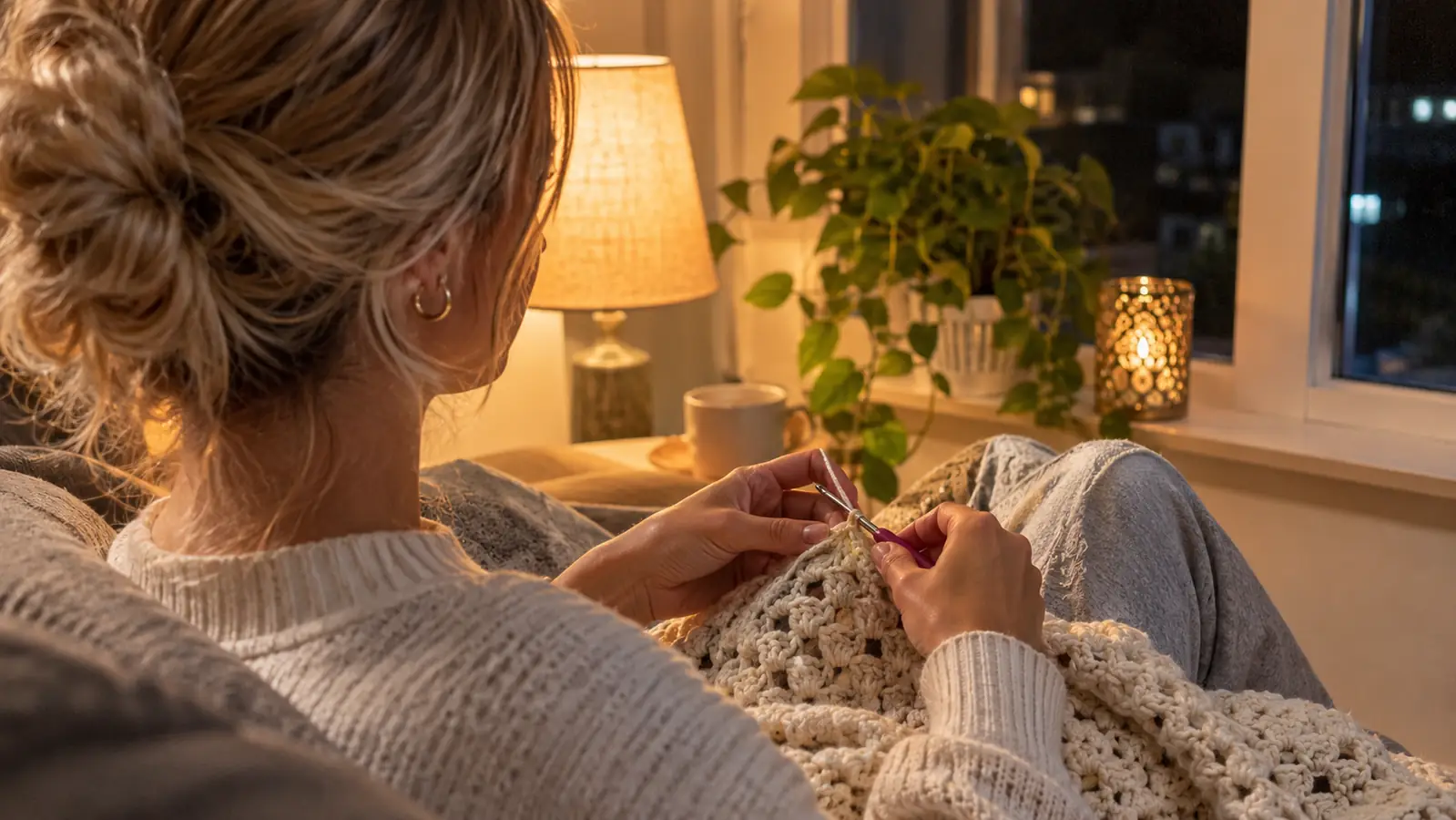
By the middle of November, the light through my front window here in Kalamazoo is gone by twenty to five, and I am not ready to stop crocheting at twenty to five. For years I kept going anyway, squinting at a row of half double crochets in a navy cotton until I had pulled out three stitches in a row because the hook went through the wrong loop. My floor lamp stands at my left, which is the wrong side for a left handed crocheter, and my own hand throws a shadow straight across the stitch I am trying to see. A Glocusent neck light around my neck is what fixed that. It took me about four evenings to stop using it wrong, and this is the routine I landed on.
I have been crocheting for about thirty five years, most of that with plain aluminum hooks and whatever lamp happened to be in the room. I bought the neck light in October 2025 and it has been on my neck most winter evenings since. I am not going to tell you it makes you a better crocheter. It does not change your tension or your gauge or the way a cotton dishcloth works up. What it does is let you see the stitch you are making at eight o'clock at night in November, which for me was the difference between finishing a row and ripping it out.
Stop working your rows by feel after dark
Glocusent Neck Light: three color temperatures, three brightness levels, four light sources, rechargeable by USB, and no hands needed. Warm white at 3200K on medium is where most of my evenings end up.
Amazon Check Today's Price on Amazon →Why the Floor Lamp Alone Stops Working After Dark
A floor lamp is a single point of light in the corner of a room. It throws light at an angle, and anything standing between the bulb and your work casts a shadow. In my chair, that thing is my left hand, which sits directly between the lamp and the row I am working. Ask any left hander who has spent an evening hunting for the back loop of a single crochet while their own knuckles throw the dark spot exactly where they need to look.
Moving the lamp does not solve it. Put it on my right and it shines in my face and makes the hook glint. Raise it and the shadow stretches out. What fixes it is a light that sits on the same side of the work as my eyes, close to the work, and travels with me when I lean forward. That is all a neck light is. It is not brighter than a good lamp. It is better placed.
The other half of the problem is that November light goes gradually, so you never notice the moment it stops being enough. At three in the afternoon I need nothing. At five I need a little. By seven I am working by feel and telling myself I will catch the mistake on the next row. I have never once caught it on the next row.
Step 1: Set the room light first, then add the neck light
The biggest mistake I made in the first week was turning off the floor lamp and working with only the neck light. It felt dramatic and cozy and it was terrible. A small pool of light in a dark room makes your eyes open and close every time you look up at the television or down at the pattern propped on the arm of the chair, and after forty minutes I was tired in a way that had nothing to do with the yarn.
So the lamp stays on, at my left, exactly where it has always been. The neck light goes on top of that, not in place of it. The lamp covers my lap, the chair, and the pattern book. The Glocusent covers the four inches where the actual stitches are, and after dark that is the only four inches I care about.
If your lamp has a dimmer, turn it down a little rather than off. You want the room lit and the work lit better. That difference between the two is what makes a stitch read as a stitch instead of a lump.
Step 2: Choose the color setting before you pick up the hook
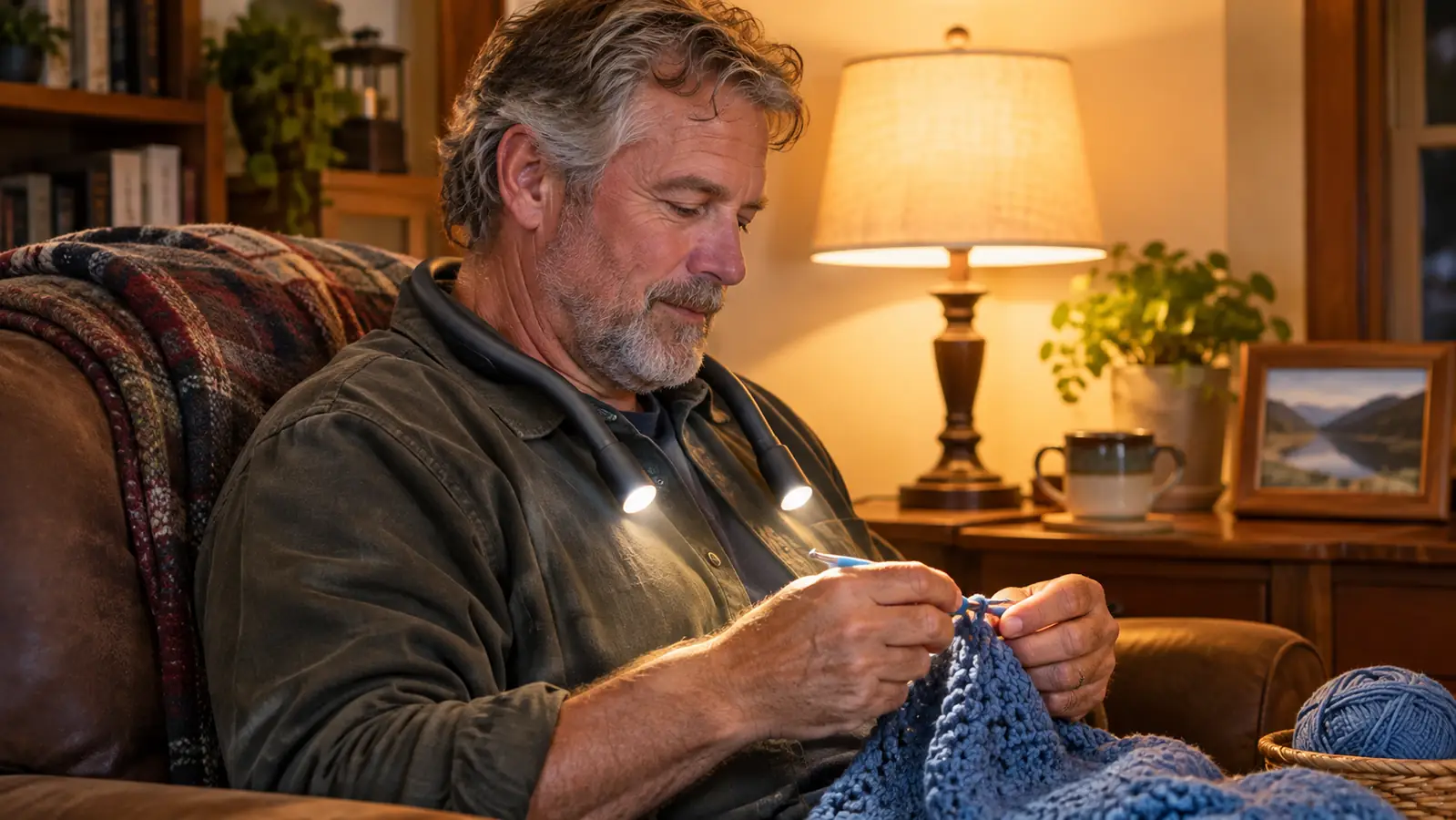
The light has three color temperatures: amber at 1800K, warm white at 3200K, and cool white. That is not a gimmick. Each one shows you a different thing, and picking the wrong one is why some people decide the whole idea does not work for them.
Amber is the gentlest of the three, and it is what I use late, when I am tired and there are two rows left and I have stopped caring about anything except finishing. It also keeps the peace in this house, because it does not throw a glare across the living room while my husband Walt is watching television in the other chair.
Warm white at 3200K is my everyday setting, on medium brightness. It is warm enough not to feel like a dentist's office and clear enough that the twist shows up in a cotton dishcloth. Cool white is the one I save for dark yarn, black yarn especially, and for anything where I am counting stitches on a small hook. It is the closest to daylight and the least restful, so it does not stay on all evening.
Step 3: Aim the two ends at your work, not at your face
This is the step people skip, and then they decide they do not like neck lights. Each end of the light turns. If you leave both ends pointing straight ahead, you are lighting the far wall and your own eyes, and no amount of brightness will rescue the row.
The beam is narrow, about ninety degrees, and there are four light sources across the two ends. A narrow beam is a good thing for crochet. It puts the light on the row instead of spraying it across the room and into somebody else's book. Turn each end down and slightly inward until the two pools of light meet right where the hook goes into the stitch.
Then sit the way you actually sit, not the way you sit for a photograph. I slide into the corner of my chair with the work about ten inches from my chest and my left shoulder dropped. I set the light for that position, because that is where I will be for the next hour. A light aimed for good posture is a light aimed at the ceiling.
Step 4: Feed the yarn so the light has something steady to land on
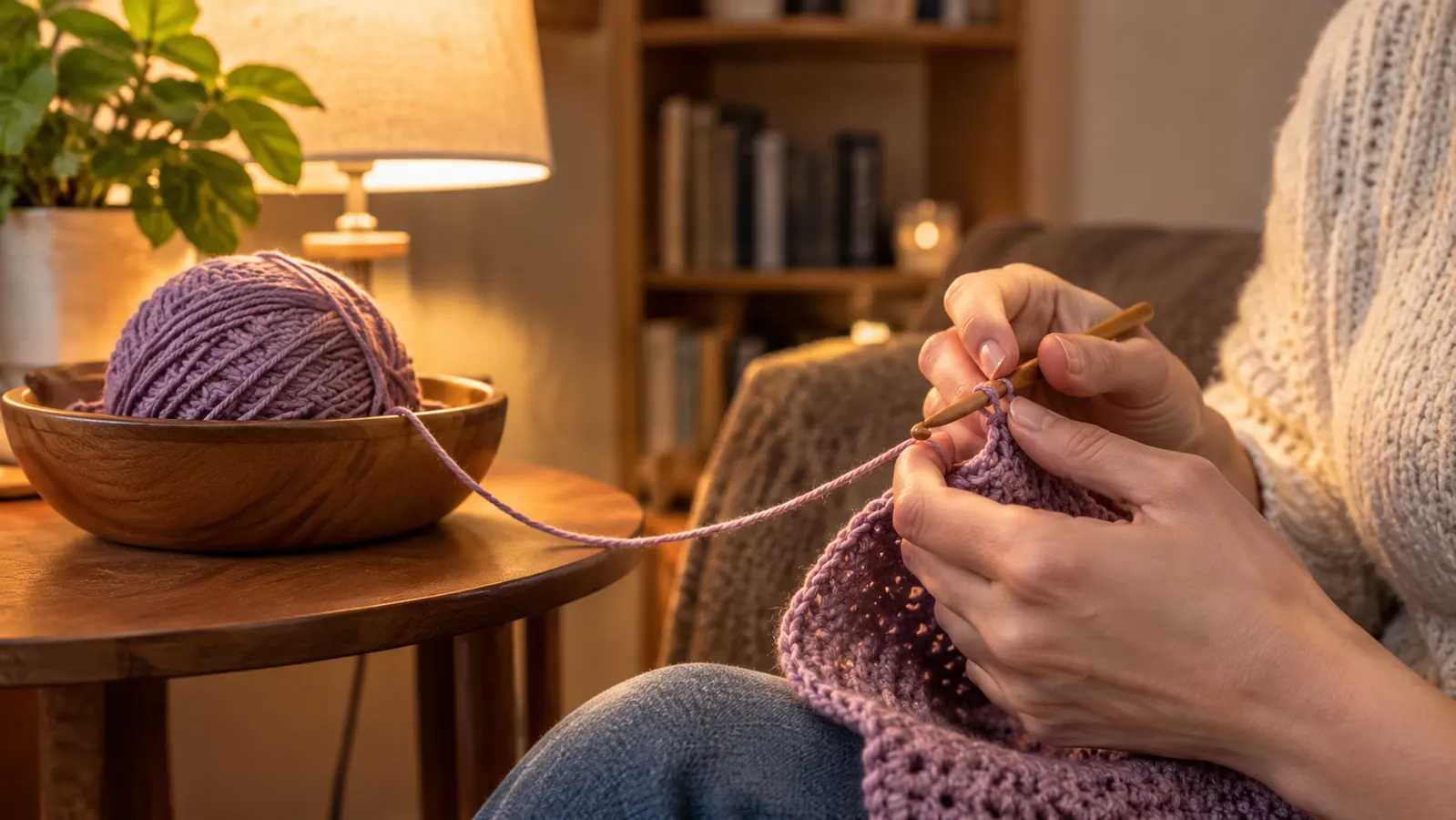
You can aim a light perfectly and still lose the row, if your ball is rolling under the chair and you are leaning sideways to fish it out. A wooden yarn bowl sits on the small table at my right and feeds the working yarn across to my left hand. It is about six inches across and three inches tall, it holds one ordinary three and a half ounce ball of worsted, and it stopped the ball rolling under the chair the first evening I used it.
The bowl is not a light, obviously. What it does is keep my shoulders square and keep the work in one place, which means the light stays aimed where I aimed it. After dark, light and posture turn out to be the same problem wearing two hats.
The other habit worth building is keeping the working row close. Holding a finished blanket out at arm's length to admire it is fine. Working out there is not. The narrow beam is generous at ten inches and ordinary at two feet, so the further you push the work away, the more you will squint, and the more you will blame the light.
Step 5: Take it off before your eyes tell you to
I work in stretches now, roughly forty minutes, and then I get up for something. There is no rule about it. It is just that somewhere past an hour my left thumb gets stiff at the base and my eyes get a flat, sandy feeling that has nothing to do with how well the light is aimed.
The light itself is light. It weighs about 126 grams, the neck area is narrowed so it sits close instead of sliding around, and I forget it is there, which is the whole point. It charges by USB with the cable that comes in the box, and I plug it in at the kitchen counter about once a week, usually Saturday morning, and that carries my evenings.
If you wear anything around your neck for two hours straight you will notice it, the same way you notice a scarf by the end of a long day. Take it off when you get up for tea. It does not need to be a permanent part of your body, and treating it like one is how people end up deciding they resent it.
My hand throws the shadow, not the lamp. Put the light around your neck and the hand stops being in the way.
What Else Helps
The light solved the seeing problem. It did not solve the thumb. I bought a set of Clover Amour hooks in September 2025 after thirty years of plain aluminum, and within about two weeks I noticed I could work roughly twenty minutes longer before I stopped to rest my hand. I use the G and the H most. The grips are symmetrical, so being left handed costs me nothing there, and the one honest complaint I have is that the handles are bulky in a small project pouch.
For sessions over an hour, and for cold weather, I wear a pair of Dritz Crafters Comfort gloves, size medium. Medium is a little roomy on my hands and I will say so plainly. They are cotton with open fingertips, they pull on, and they are hand wash only. They felt warmer right away, and by about the second week I noticed less stiffness at the end of an evening. That is comfort, not a cure, and I would not pretend otherwise.
The rest is transport. My project lives in a canvas CRAFTISS bag, about ten by ten by twelve inches, with a zipper, a removable divider and three outside pockets. Hooks go in the zippered case that came with it, gloves in an outside pocket, and the yarn feeds through the top slots only when I am away from home. At five foot one I carry it by the top handle, because the shoulder strap hangs the bag down around my knees.
One last thing, and it is not a product. My feet do not reach the floor flat in most armchairs, so I keep a small footstool by the chair. Dangling feet pull your back forward, and a back that is forward puts your work somewhere the light is no longer aimed. Set the chair up so you can sit still for forty minutes, and the light will do the rest of its job without any help from you.
Set the ends once, then forget it is there
Three color temperatures, three brightness levels, four light sources, cordless and hands free. Charge it once a week at the kitchen counter and it is ready when the window goes dark at twenty to five.
Amazon Check Today's Price on Amazon →