
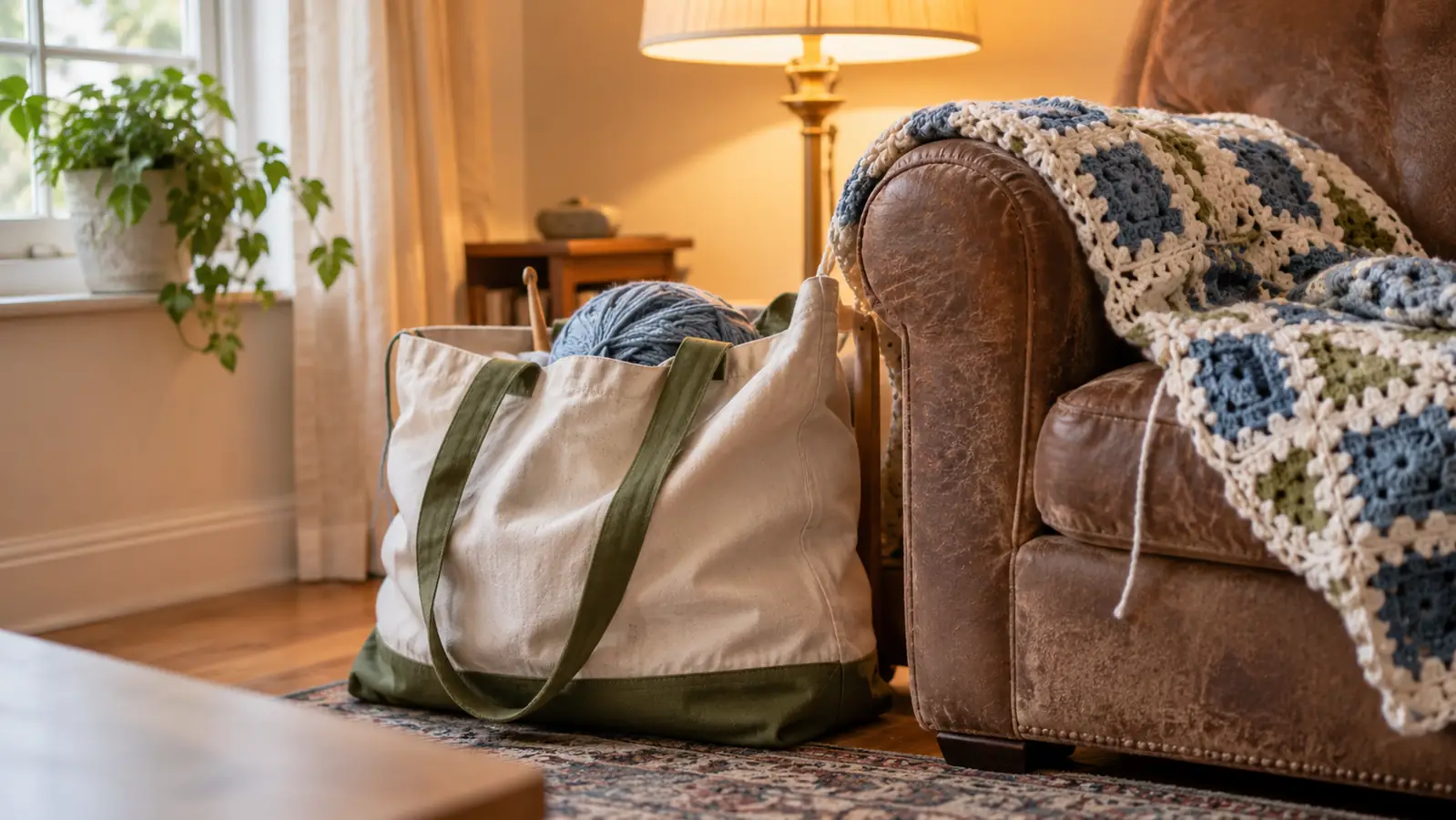
For about thirty years my crochet supplies lived in a canvas library tote. It was a good tote. It was not a good system. Hooks slid down into the bottom corner and stayed there, so every project started with me upending the whole thing on the kitchen table and picking through the pile. Patterns got folded into quarters and then into eighths. Whatever I was working on went in last and came out looking like it had been slept on.
I bought the CRAFTISS Crochet Bag in May 2026, mostly out of irritation. Six months later I can tell you what actually changed, and it was not that the bag is beautiful or that it has a lot of pockets. It is that the bag has a place for each thing, so putting a thing away takes two seconds instead of twenty. Below is the order I did it in. If you follow the steps in order, you will not end up with a bag full of loose hooks and no room for the blanket you are supposed to be making.
One bag that holds the project, the hooks and the pattern without a single thing falling to the bottom
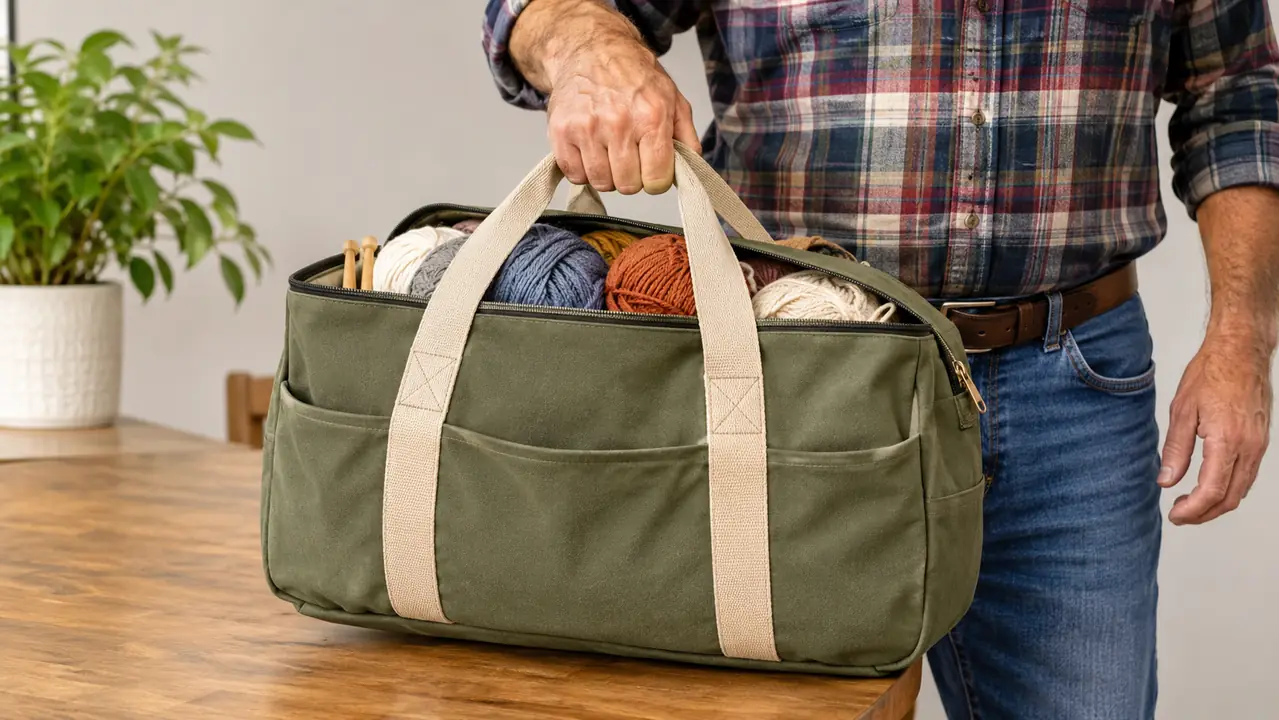
The CRAFTISS bag is canvas, zips shut, and has a removable divider, three deep outside pockets and an included zippered case. It is what I moved into after years of losing hooks in a tote.
Amazon Check Today's Price on Amazon →Before You Start: Empty Everything Out
Not sort. Empty. Dump the whole tote on the table and do not let yourself put a single item back until you have looked at it. I found four tapestry needles, two printed patterns I had already made, three partial balls of cotton from dishcloths finished two summers ago, and a hook I had been looking for since the previous winter. It was a size H.
Sort into three piles: what belongs to the project you are working on right now, what you want to keep but is not in play, and what goes out of the house. Be honest about the third pile. If you have not touched it in two years, you will not touch it in the next two, and it is taking up room in a bag that has a specific job. My church's winter drive takes yarn donations, which made the third pile easy to be honest about.
Step 1: Decide What the Bag Is For, and Let It Be Only That
This is the step I got wrong at first. My instinct was to put everything in the new CRAFTISS bag, because it was large and everything fit. Within a week it was the library tote again, only heavier. A bag that holds everything is a bag that holds nothing useful, because you cannot find the one thing you need without going through the other forty.
What worked was deciding the bag carries one active project at a time. Right now that is a baby blanket in a soft acrylic, plus the hooks in the zippered case, plus the gloves in an outside pocket. The yarn bowl stays on the side table at home and never goes in. That is a rule I keep. When I start something new, the old project comes out entirely before the new one goes in.
This bag is about 10 by 10 by 12 inches, canvas, and it has four compartments with the divider in place. That is enough for one large project or two small ones. It is not enough to be the closet. Keeping a separate lidded box in the hall closet for the not-in-play pile is the thing that makes the bag work. Mine holds the cotton odds and ends and the shawl yarn I bought on sale in September and will not touch until the blankets are done.
Step 2: Set the Bottom Before You Put Anything In It
The bottom of a bag is where small things go to disappear. The fix is to make the bottom of the bag not be the bottom. The divider is removable, and for a blanket project I take it out, because one open space holds a large skein or a cake without the divider pressing on it. For a hat or a dishcloth project I put the divider back and use the two sides to separate the working yarn from the finished pieces.
The included zippered case goes in first, and it goes in on the short end. That case holds my Clover Amour hooks, the ten from B-2.25mm through J-6.00mm, plus a tape measure and a few stitch markers. I am left-handed and I hold the hook in my left hand, working right to left mirrored, but a case does not care which hand you use, which is a small mercy. Because the case is a fixed shape at one end, the rest of the bag has a wall to lean against and stays where I put it.
Before this, my hooks lived loose in the tote. Loose hooks in a canvas bag find the seam and stay there. The zippered case ended that, and the case is the reason the CRAFTISS bag works for me rather than the pockets. If you already own a hook roll you like, use it and put it in the same spot. The point is not the case. The point is that hooks stop roaming, and the spot stops moving from week to week.
Step 3: Load the Project, Then Load the Yarn Slots
Put the project in next, not first. If you put the yarn in first, the project sits on top of it and compresses it, and you end up with a bag you have to dig through from the top down like a suitcase packed wrong.
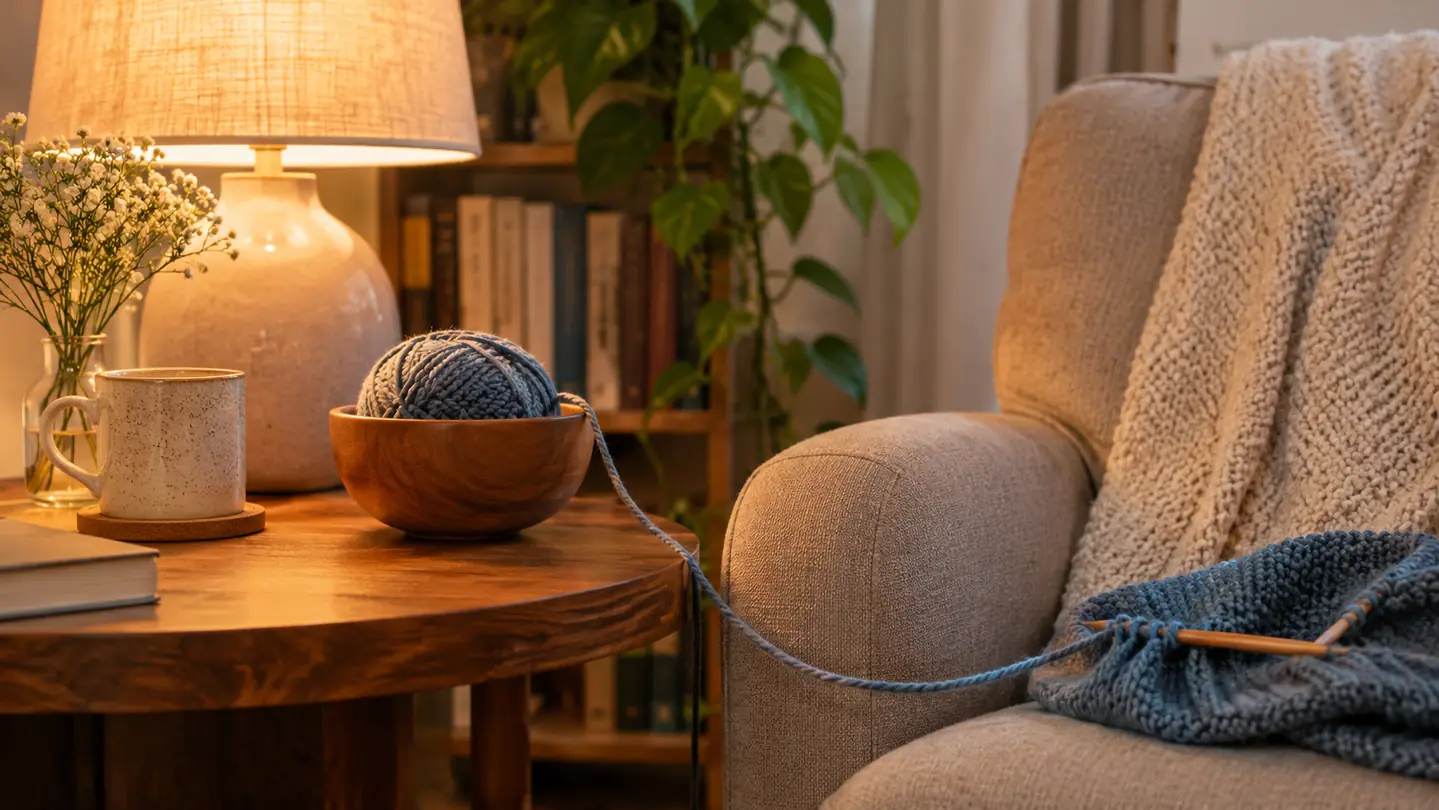
The top has yarn slots, and those are for travel only. At home, in my armchair by the front window, I feed yarn from the wooden bowl on the side table to my right and I do not use the slots at all. When Walt and I drive to see our daughter Beth, about once a month and two hours each way, the slots hold the working yarn so it does not roll around the car floor. That is the whole job. It is a small feature and I would not have guessed it would matter, but a ball of cotton rolling under the passenger seat is a thing I no longer deal with.
If you crochet in the car as a passenger, thread the yarn through a slot before you sit down, not after the car is moving. I learned that one on I-94. And if you are packing two small projects instead of one big one, use the divider and give each project its own side, with its own yarn. Do not mix the working yarns in the open space. Two colors in one compartment on a two hour drive is how you end up untangling instead of crocheting.
Step 4: Use the Outside Pockets for the Things You Reach For
There are three deep outside pockets, and they should hold only what you touch during a session. Mine go like this. Front pocket: the Dritz Crafters Comfort gloves. Left pocket: a small pair of scissors and a needle case. Right pocket: the printed pattern for the current project, folded once and not four times.
The test for whether something belongs in an outside pocket is simple. Did you reach for it during your last session? If you did not, it belongs inside, or in the closet box. Pockets that fill up with things you never touch become inaccessible, because you have to unload them to get to the one item you actually wanted.
The gloves are a good example of a pocket item and not a bag item. I wear them for any session over about an hour and in cold weather, and I pull them off the moment I stop. So they need to be reachable in one motion, which means an outside pocket. When I had them loose in the tote I would skip putting them on because finding them was more trouble than the stiffness at the base of my thumb was worth, and then I would pay for it an hour later.
Step 5: Give It a Home and a Closing Routine
The bag lives on the floor beside my armchair, within reach of my left hand. That is the only place it lives when it is in the house. Not the closet, not the spare room, not wherever it lands. If it has one home, you will put it back, and if you put it back, the routine holds.
The closing routine takes under a minute. Hooks back in the zippered case. Working yarn off the hook and the hook out of the stitch. Pattern back in its pocket. Zipper closed. The zipper matters more than it sounds. The lid of a canvas bag that stays open in a room with a floor lamp and a foot traffic path is a bag that gets things dropped into it by accident, usually by a husband who is looking for the mail.
At 5 foot 1 I carry it by the top handle rather than the shoulder strap. The strap is fine and it is adjustable, but on me the bag hangs low and bumps my leg when I walk, so the top handle is what I actually use from the chair to the car. If you are taller, the strap will probably be the better choice. The CRAFTISS bag weighs 1.4 pounds empty, which is light enough that the handle is not a burden even loaded with a blanket.
The change was not the bag. The change was that every item got one place, and putting it back took two seconds instead of twenty.
What Else Helps
The bag solved carrying and storing. It did not solve everything, and I want to be clear about that because a bag that is sold as an organizer can start to feel like it should organize your whole hobby.
A yarn bowl on a side table is what stops the ball rolling under the chair. Mine is about 6 inches across and 3 inches tall, it fits one 3.5 ounce ball and not a jumbo skein, and it stays home. The bag feeds yarn through the slots when I am away and the bowl feeds it when I am here. Two jobs, two tools, and neither one is trying to do the other's work.
A neck light is worth having if you work after dark in a chair with a lamp on one side. My floor lamp stands at my left and my left hand throws a shadow across the stitches, so the light around my neck fills in what the lamp cannot reach. I use it on the warm white setting on medium, evenings only, on top of the lamp and never instead of it. Walt noticed it before I did and asked whether I had joined a mining crew.
And a hard sided box in a closet for the not-in-play yarn. The bag is a working bag. The box is the inventory. Keeping those two separate is the difference between a system and a pile with a zipper on it. Blocking still happens on the kitchen table, because a 10 inch bag is not a blocking board and should not try to be. If you want the short version of why any of this is worth the floor space, the ten reasons a project bag earns its spot are worth a read, and I would also point you at how the CRAFTISS bag compares with a plain tote before you spend anything, because a tote is free if you already own one and it still works for some people.
Six months in, the zipper, the divider and the hook case are what I would buy it for again
Canvas, about 10 by 10 by 12 inches, four compartments with the divider in, three deep outside pockets and an included zippered case. Carries one active project without it turning into a jumble.
Amazon Check Today's Price on Amazon →